
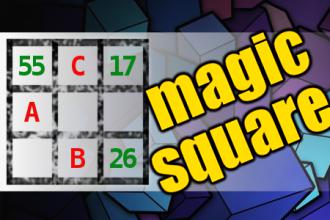
MAGIC SQUARE: Calculate A+B*C
[6061] MAGIC SQUARE: Calculate A+B*C - The aim is to place the some numbers from the list (15, 16, 17, 25, 26, 27, 33, 54, 55, 56, 61) into the empty squares and squares marked with A, B an C. Sum of each row and column should be equal. All the numbers of the magic square must be different. Find values for A, B, and C. Solution is A+B*C. - #brainteasers #math #magicsquare - Correct Answers: 13 - The first user who solved this task is Nílton Corrêa de Sousa
BRAIN TEASERS
enter your answer and press button OK

MAGIC SQUARE: Calculate A+B*C

The aim is to place the some numbers from the list (15, 16, 17, 25, 26, 27, 33, 54, 55, 56, 61) into the empty squares and squares marked with A, B an C. Sum of each row and column should be equal. All the numbers of the magic square must be different. Find values for A, B, and C. Solution is A+B*C.
Correct answers: 13
The first user who solved this task is Nílton Corrêa de Sousa.
#brainteasers #math #magicsquare
Register with your Google Account and start collecting points.
Check your ranking on list.

Fishing in a puddle

The rain was pouring and there was a big puddle in front of the pub.

A ragged old man was standing there with a rod and hanging a string into the puddle.

A tipsy- looking, curious gentleman came over to him and asked what he was doing.

'Fishing,' the old man said simply.

'Poor old fool,' the gentleman thought and he invited the ragged old man to a drink in the pub.

As he felt he should start some conversation while they were sipping their whiskey, the gentleman asked,

'And how many have you caught?'

‘You're the eighth.‘

Found on Tell Funny Stories - A willing victim letting himself be caught joke, posted October 24, 2010

Jokes of the day - Daily updated jokes. New jokes every day.
Follow Brain Teasers on social networks

Brain Teasers

puzzles, riddles, mathematical problems, mastermind, cinemania...

Edison patent

In 1882, Thomas A. Edison was issued a patent for an improvement to the telephone (No. 252,442). It described a carbon microphone. Finely divided conducting material, such as carbon, between metal cups mounted on arms is attached to the mouthpiece diaphragm. As sound waves directed through the mouthpiece move the diaphragm, the arms change the pressure on the carbon button which in turn varies an electric current passing through the carbon button. Changes in the current correspond to the pitch and amplitude of the sound. One arm conducts the electrical current to the carbon button, and the the other from it.
This site uses cookies to store information on your computer. Some are essential to help the site properly. Others give us insight into how the site is used and help us to optimize the user experience. See our privacy policy.