MAGIC SQUARE: Calculate A-B*C
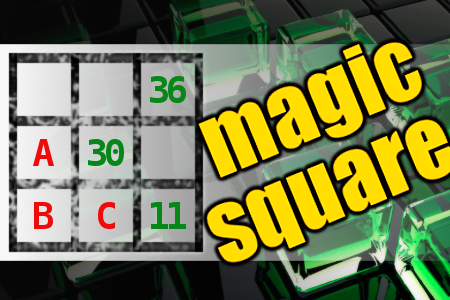
[6068] MAGIC SQUARE: Calculate A-B*C - The aim is to place the some numbers from the list (11, 12, 17, 30, 31, 36, 44, 68, 69, 74) into the empty squares and squares marked with A, B an C. Sum of each row and column should be equal. All the numbers of the magic square must be different. Find values for A, B, and C. Solution is A-B*C. - #brainteasers #math #magicsquare - Correct Answers: 11 - The first user who solved this task is Nasrin 24 T
BRAIN TEASERS
enter your answer and press button OK

MAGIC SQUARE: Calculate A-B*C

The aim is to place the some numbers from the list (11, 12, 17, 30, 31, 36, 44, 68, 69, 74) into the empty squares and squares marked with A, B an C. Sum of each row and column should be equal. All the numbers of the magic square must be different. Find values for A, B, and C. Solution is A-B*C.
Correct answers: 11
The first user who solved this task is Nasrin 24 T.
#brainteasers #math #magicsquare
Register with your Google Account and start collecting points.
Check your ranking on list.

Hubby: You always carry my pho...

Hubby: You always carry my photo in your handbag to the office. Why?
Wife: When there is a problem, no matter how impossible, I look at your picture and the problem disappears.
Hubby: You see, how miraculous and powerful I am for you?
Wife: Yes, I see your picture and say to myself, "What other problem can there be greater than this one?"
Jokes of the day - Daily updated jokes. New jokes every day.
Follow Brain Teasers on social networks

Brain Teasers

puzzles, riddles, mathematical problems, mastermind, cinemania...

Black American patent

In 1896, black American inventor, Willie H. Johnson, of Navasota, Texas, was issued a U.S. patent for "A Mechanism for Overcoming Dead Centers" which occur in machines when a shaft is driven by a crank (No. 554,223). The essential part of his invention consisted of a two-part or compound crank-rod of such construction that the members automatically locked together at the proper point in the stroke, so as to act as a single rod, and at other intervals of its travel would automatically unlocked, so that each member would act independently of the other. Either could act to carry the stroke past the top dead center of the other. Johnson secured a second patent in Oct 1898 for an improvement to his design (No. 612,345).
This site uses cookies to store information on your computer. Some are essential to help the site properly. Others give us insight into how the site is used and help us to optimize the user experience. See our privacy policy.