MAGIC SQUARE: Calculate A+B*C
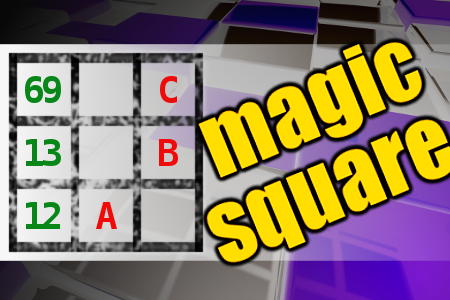
[6145] MAGIC SQUARE: Calculate A+B*C - The aim is to place the some numbers from the list (3, 5, 7, 10, 12, 13, 18, 36, 69, 71, 77, 78) into the empty squares and squares marked with A, B an C. Sum of each row and column should be equal. All the numbers of the magic square must be different. Find values for A, B, and C. Solution is A+B*C. - #brainteasers #math #magicsquare - Correct Answers: 13 - The first user who solved this task is Nasrin 24 T
BRAIN TEASERS
enter your answer and press button OK

MAGIC SQUARE: Calculate A+B*C

The aim is to place the some numbers from the list (3, 5, 7, 10, 12, 13, 18, 36, 69, 71, 77, 78) into the empty squares and squares marked with A, B an C. Sum of each row and column should be equal. All the numbers of the magic square must be different. Find values for A, B, and C. Solution is A+B*C.
Correct answers: 13
The first user who solved this task is Nasrin 24 T.
#brainteasers #math #magicsquare
Register with your Google Account and start collecting points.
Check your ranking on list.

A man is at work one day when...

A man is at work one day when he notices that his co-worker is wearing an earring.
This man knows his co-worker to be a normally conservative fellow, and is curious about his sudden change in "fashion sense."
The man walks up to him and says, "I didn't know you were into earrings."
"Don't make such a big deal out of this, it's only an earring," he replies sheepishly.
His friend falls silent for a few minutes, but then his curiosity prods him to say, "So, how long have you been wearing one?"
"Ever since my wife found it in my truck..."
Jokes of the day - Daily updated jokes. New jokes every day.
Follow Brain Teasers on social networks

Brain Teasers

puzzles, riddles, mathematical problems, mastermind, cinemania...

Alfred Werner

Born 12 Dec 1866; died 15 Nov 1919 at age 52.Swiss chemist whose founding research into the structure of coordination compounds brought him the 1913 Nobel Prize for Chemistry. He demonstrated that stereochemistry was not just the property of carbon compounds, but was general to the whole of chemistry. His theory of chemical coordination (1893) recognized that many metals appeared to show variable valence and form complex compounds. Certain metals, such as cobalt and platinum, were capable through their secondary valences of joining to themselves a certain number of atoms or molecules. These were termed by Werner “coordination compounds.”and the maximum number of atoms (or “ligands”as he called them) that can be joined to the central metal is its coordination number.
This site uses cookies to store information on your computer. Some are essential to help the site properly. Others give us insight into how the site is used and help us to optimize the user experience. See our privacy policy.