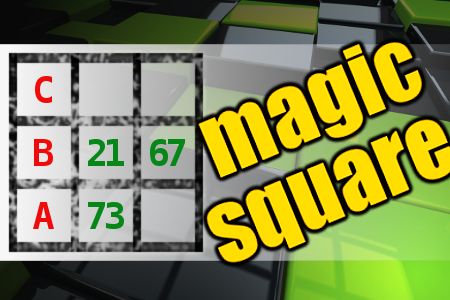
MAGIC SQUARE: Calculate A-B-C
[6256] MAGIC SQUARE: Calculate A-B-C - The aim is to place the some numbers from the list (5, 8, 11, 18, 21, 24, 31, 67, 70, 73, 84, 95) into the empty squares and squares marked with A, B an C. Sum of each row and column should be equal. All the numbers of the magic square must be different. Find values for A, B, and C. Solution is A-B-C. - #brainteasers #math #magicsquare - Correct Answers: 9 - The first user who solved this task is Nílton Corrêa de Sousa
BRAIN TEASERS
enter your answer and press button OK

MAGIC SQUARE: Calculate A-B-C

The aim is to place the some numbers from the list (5, 8, 11, 18, 21, 24, 31, 67, 70, 73, 84, 95) into the empty squares and squares marked with A, B an C. Sum of each row and column should be equal. All the numbers of the magic square must be different. Find values for A, B, and C. Solution is A-B-C.
Correct answers: 9
The first user who solved this task is Nílton Corrêa de Sousa.
#brainteasers #math #magicsquare
Register with your Google Account and start collecting points.
Check your ranking on list.

Tom was at the hospital visiti...

Tom was at the hospital visiting with his best friend Larry who was dying. Tom asked, "If there is baseball in heaven will you come back and tell me?" Larry nodded yes just as he passed away. That night while Tom was sleeping, he heard Larry's voice in a dream, "Tom..." "Larry! What is it?!" asked Tom. "I have good news and bad news from heaven." "What's the good news?" "There is baseball in heaven after all, but the bad news is you're pitching on Tuesday."
Jokes of the day - Daily updated jokes. New jokes every day.
Follow Brain Teasers on social networks

Brain Teasers

puzzles, riddles, mathematical problems, mastermind, cinemania...

Kurt Alder

Died 20 Jun 1958 at age 55 (born 10 Jul 1902).German chemist was the corecipient (with Otto Diels) of the Nobel Prize for Chemistry in 1950 for their development of the Diels-Alder reaction (1928), or diene synthesis, a widely used method of synthesizing cyclic organic compounds. In this type of reaction, a compound containing two double bonds separated by a single bond (i.e. a conjugated diene) adds to a suitable compound containing one double bond (dienophile) to give a ring compound. In the dienophile, the double bond must have a carbonyl group on each side. The reaction proceeds in the mildest conditions, is of general application, and hence of great utility in synthesis. It is used in the synthesis of natural products, such as sterols, vitamin K, cantharides, and synthetic polymers.
This site uses cookies to store information on your computer. Some are essential to help the site properly. Others give us insight into how the site is used and help us to optimize the user experience. See our privacy policy.