
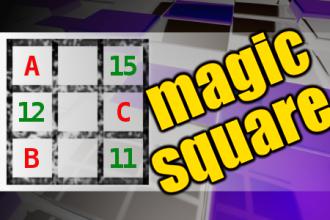
MAGIC SQUARE: Calculate A-B*C
[6263] MAGIC SQUARE: Calculate A-B*C - The aim is to place the some numbers from the list (7, 10, 11, 12, 14, 15, 34, 38, 39, 94) into the empty squares and squares marked with A, B an C. Sum of each row and column should be equal. All the numbers of the magic square must be different. Find values for A, B, and C. Solution is A-B*C. - #brainteasers #math #magicsquare - Correct Answers: 9 - The first user who solved this task is Nílton Corrêa de Sousa
BRAIN TEASERS
enter your answer and press button OK

MAGIC SQUARE: Calculate A-B*C

The aim is to place the some numbers from the list (7, 10, 11, 12, 14, 15, 34, 38, 39, 94) into the empty squares and squares marked with A, B an C. Sum of each row and column should be equal. All the numbers of the magic square must be different. Find values for A, B, and C. Solution is A-B*C.
Correct answers: 9
The first user who solved this task is Nílton Corrêa de Sousa.
#brainteasers #math #magicsquare
Register with your Google Account and start collecting points.
Check your ranking on list.

Biggest j*rks

Morton was reading the paper after breakfast when he came across an article about a beautiful actress who was about to marry a football player known primarily for his lack of IQ and common sense.

He turned to his wife with a questioning look on his face and said: "I'll never understand why the biggest j*rks get the most attractive wives."

His wife smiled and replied: "Why thank you, dear!"

Jokes of the day - Daily updated jokes. New jokes every day.
Follow Brain Teasers on social networks

Brain Teasers

puzzles, riddles, mathematical problems, mastermind, cinemania...

Sir William McCrea

Born 13 Dec 1904; died 25 Apr 1999 at age 94. Sir William Hunter McCrea was an Irish theoretical astrophysicist whose early work was in quantum physics, relativity and pure mathmatics, but he gradually turned to applying theoretical physics in astronomy. He ranged from considering the stellar atmospheres, planet formation, cosmology and indeed, the formation of stars and the universe. He was an early advocate that stars have a high hydrogen content. He studied gas dynamics, as in the formation of hydrogen in molecular form in dusty interstellar clouds, and developed a theory of the transition from increasing density to conditions sufficient for gravitational collapse and possible star formation. Although he at first was open-minded to the steady state theory of the universe proposed by Hermann Bondi, Thomas Gold and Fred Hoyle, McCrea's work and others accumulated evidence for the Big Bang theory.«
This site uses cookies to store information on your computer. Some are essential to help the site properly. Others give us insight into how the site is used and help us to optimize the user experience. See our privacy policy.