MAGIC SQUARE: Calculate A-B+C
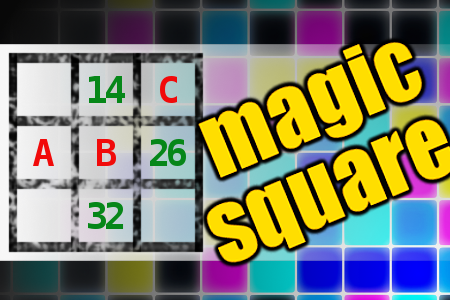
[6351] MAGIC SQUARE: Calculate A-B+C - The aim is to place the some numbers from the list (14, 16, 20, 23, 25, 26, 28, 29, 32, 71, 81) into the empty squares and squares marked with A, B an C. Sum of each row and column should be equal. All the numbers of the magic square must be different. Find values for A, B, and C. Solution is A-B+C. - #brainteasers #math #magicsquare - Correct Answers: 17 - The first user who solved this task is Nílton Corrêa de Sousa
BRAIN TEASERS
enter your answer and press button OK

MAGIC SQUARE: Calculate A-B+C

The aim is to place the some numbers from the list (14, 16, 20, 23, 25, 26, 28, 29, 32, 71, 81) into the empty squares and squares marked with A, B an C. Sum of each row and column should be equal. All the numbers of the magic square must be different. Find values for A, B, and C. Solution is A-B+C.
Correct answers: 17
The first user who solved this task is Nílton Corrêa de Sousa.
#brainteasers #math #magicsquare
Register with your Google Account and start collecting points.
Check your ranking on list.

April Fool's Day - Here are 5 pranks you can play on people

1. Hard boil all the eggs in the carton and place them back in the refrigerator.
2. Paint a bar of soap completely with clear nail polish so it won’t suds up.
3. Turn every setting in someone’s car to the maximum: the heat, the radio, the wipers, the seats, etc.
4. Place a small piece of Post-it note over the ball under someone’s computer mouse so that it won’t work.
5. Switch the handles on the refrigerator to the side that doesn’t open.
Jokes of the day - Daily updated jokes. New jokes every day.
Follow Brain Teasers on social networks

Brain Teasers

puzzles, riddles, mathematical problems, mastermind, cinemania...

Charles Frederick Cross

Died 15 Apr 1935 at age 79 (born 11 Dec 1855).English chemist who, with Edward Bevan and Clayton Beadle, discovered cellulose could be produced (1891) by the dissolution of cellulose xanthate in dilute sodium hydroxide. Although cellulose had previously been made by others, this type of cellulose is the most popular type in use today. It was a syrupy yellow liquid. In 1892, Cross worked out a method for dissolving cellulose in carbon disulphide (producing a solution he called viscose) which could be squirted out of fine holes. As the solvent evaporated, a fine fibre was formed which became known as viscose rayon (or simply viscose). By 1908, the viscose was also used extruded through a narrow slit to produce thin, transparent sheets of cellophane.
This site uses cookies to store information on your computer. Some are essential to help the site properly. Others give us insight into how the site is used and help us to optimize the user experience. See our privacy policy.