MAGIC SQUARE: Calculate A+B-C
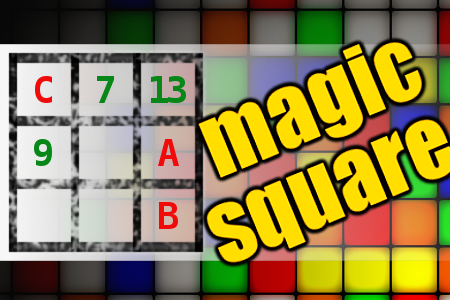
[6482] MAGIC SQUARE: Calculate A+B-C - The aim is to place the some numbers from the list (7, 8, 9, 11, 12, 13, 25, 36, 69, 70, 71, 82, 83) into the empty squares and squares marked with A, B an C. Sum of each row and column should be equal. All the numbers of the magic square must be different. Find values for A, B, and C. Solution is A+B-C. - #brainteasers #math #magicsquare - Correct Answers: 10 - The first user who solved this task is Nasrin 24 T
BRAIN TEASERS
enter your answer and press button OK

MAGIC SQUARE: Calculate A+B-C

The aim is to place the some numbers from the list (7, 8, 9, 11, 12, 13, 25, 36, 69, 70, 71, 82, 83) into the empty squares and squares marked with A, B an C. Sum of each row and column should be equal. All the numbers of the magic square must be different. Find values for A, B, and C. Solution is A+B-C.
Correct answers: 10
The first user who solved this task is Nasrin 24 T.
#brainteasers #math #magicsquare
Register with your Google Account and start collecting points.
Check your ranking on list.

A Pint of Less

A customer walked into a bar and said, “I’ll have a pint of less, please.”
“Less?” queried the bartender. “What’s that?”
“I don’t know either,” said the customer, “but my doctor told me to drink less.”

Jokes of the day - Daily updated jokes. New jokes every day.
Follow Brain Teasers on social networks

Brain Teasers

puzzles, riddles, mathematical problems, mastermind, cinemania...

Separable Baggage Ticket

In 1882, John Mitchell Lyons was issued a Canadian patent for his "Improvements in Baggage Checks and Coupon Tickets" (No. 14911). He was a railway clerk in Moncton, New Brunswick, Canada, who devised this now familiar way to track and identify luggage. As the headquarters of the Intercolonial Railway of Canada, Moncton was an important railway hub. To better control the passengers' luggage, Lyons devised a baggage check which separated along a perforation into two halves. Both pieces were printed with the same route information and an identifying number. One half was attached to the bag, and the other was given to the passager to claim his luggage at his destination.«[Image: figure from Canadian patent.]
This site uses cookies to store information on your computer. Some are essential to help the site properly. Others give us insight into how the site is used and help us to optimize the user experience. See our privacy policy.