MAGIC SQUARE: Calculate A-B+C
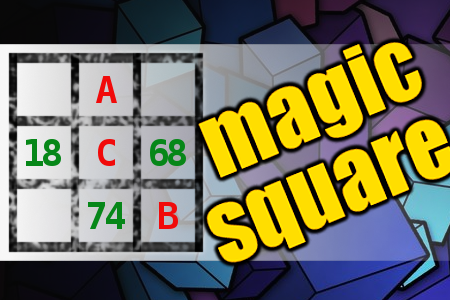
[6715] MAGIC SQUARE: Calculate A-B+C - The aim is to place the some numbers from the list (2, 9, 12, 18, 23, 26, 32, 65, 68, 74) into the empty squares and squares marked with A, B an C. Sum of each row and column should be equal. All the numbers of the magic square must be different. Find values for A, B, and C. Solution is A-B+C. - #brainteasers #math #magicsquare - Correct Answers: 13 - The first user who solved this task is Nasrin 24 T
BRAIN TEASERS
enter your answer and press button OK

MAGIC SQUARE: Calculate A-B+C

The aim is to place the some numbers from the list (2, 9, 12, 18, 23, 26, 32, 65, 68, 74) into the empty squares and squares marked with A, B an C. Sum of each row and column should be equal. All the numbers of the magic square must be different. Find values for A, B, and C. Solution is A-B+C.
Correct answers: 13
The first user who solved this task is Nasrin 24 T.
#brainteasers #math #magicsquare
Register with your Google Account and start collecting points.
Check your ranking on list.

New Submarine Ensign

The new Ensign was assigned to subs, where he'd dreamed of working since a young boy.
He was trying to impress the Master Chief with his expertise learned in Submarine School.
The Master Chief cut him off quickly and said, "Listen, 'sir', it's real simple. Add the number of times we dive to the number of times we surface. Divide that number by two. If the result doesn't come out even, don't open the hatch."
Jokes of the day - Daily updated jokes. New jokes every day.
Follow Brain Teasers on social networks

Brain Teasers

puzzles, riddles, mathematical problems, mastermind, cinemania...

Liquifaction of oxygen

In 1879, the liquefaction of oxygen was announced by Raoul Pierre Pictet (1846-1929), a Swiss chemist and physicist, by sending a telegram to the French Academy: Oxygen liquefied today under 320-atm and 140 degrees of cold by combined use of sulfurous and carbonic acid. French physicist Louis Cailletet made a similar announcement two days later. Pictet's early interest was in ice-making machines. Later, he studied extremely low temperatures and the liquefaction of gases. Both Pictet and Cailletet used both cooling and compression to liquefy oxygen but they achieved this using different techniques. Pictet's method had an advantage in that produced the liquid gas in greater quantity and was easier to apply to other gases.[Image: part of a Pictet machine to cool down glycerine, which was pumped through a piping system in the first artificial skating track:]
This site uses cookies to store information on your computer. Some are essential to help the site properly. Others give us insight into how the site is used and help us to optimize the user experience. See our privacy policy.