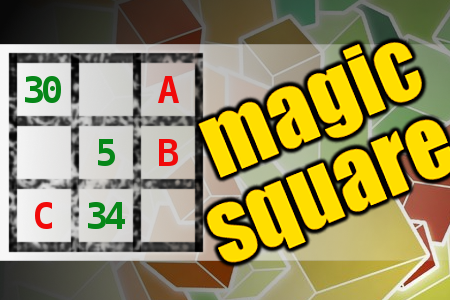
MAGIC SQUARE: Calculate A*B*C
[6819] MAGIC SQUARE: Calculate A*B*C - The aim is to place the some numbers from the list (5, 8, 9, 18, 21, 22, 30, 33, 34, 44, 52, 93) into the empty squares and squares marked with A, B an C. Sum of each row and column should be equal. All the numbers of the magic square must be different. Find values for A, B, and C. Solution is A*B*C. - #brainteasers #math #magicsquare - Correct Answers: 13 - The first user who solved this task is Nasrin 24 T
BRAIN TEASERS
enter your answer and press button OK

MAGIC SQUARE: Calculate A*B*C

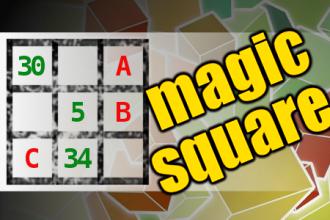
The aim is to place the some numbers from the list (5, 8, 9, 18, 21, 22, 30, 33, 34, 44, 52, 93) into the empty squares and squares marked with A, B an C. Sum of each row and column should be equal. All the numbers of the magic square must be different. Find values for A, B, and C. Solution is A*B*C.
Correct answers: 13
The first user who solved this task is Nasrin 24 T.
#brainteasers #math #magicsquare
Register with your Google Account and start collecting points.
Check your ranking on list.

Chihuahua at the vets

A man brings his Chihuahua to the vet.
They’re immediately taken to a room.
Soon, a Labrador walks in sniffs the Chihuahua, and leaves.
Then a cat comes in, stares at the dog, and leaves.
Finally, the doctor comes in, prescribes some medicine, and hands the man a $250 bill.
"This must be a mistake," the man says.
"I’ve only been here 20 minutes!"
"No mistake," the doctor says.
"It’s $100 for the Lab test,
$100 for the cat scan,
and $50 for the medicine."
Jokes of the day - Daily updated jokes. New jokes every day.
Follow Brain Teasers on social networks

Brain Teasers

puzzles, riddles, mathematical problems, mastermind, cinemania...

Metre

In 1889, the third legal definition of the metre was adopted at the Paris General Conference. An international prototype metre bar was made of a 90-10 platinum-iridium alloy with an X cross section to minimize flexing. The metre was defined as the distance measured between two lines on the bar at the temperature of freezing water, 0°C. The alloy ingot was made possible by a high-temperature furnace devised by Henry Sainte-Claire and his assistant Jules Henry Debray. The alloy was harder than pure platinum, but retained the other desireable properties, including resistance to corrosion. Duplicate prototypes were made and distributed to each of the countries that joined in the international agreement. The same alloy was used to prepare the international protype of the kilogram.«
This site uses cookies to store information on your computer. Some are essential to help the site properly. Others give us insight into how the site is used and help us to optimize the user experience. See our privacy policy.