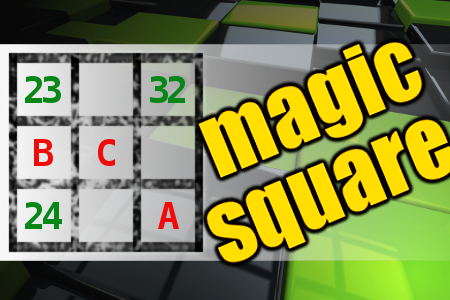
MAGIC SQUARE: Calculate A-B+C
[6833] MAGIC SQUARE: Calculate A-B+C - The aim is to place the some numbers from the list (5, 6, 13, 22, 23, 24, 25, 30, 32, 50, 99) into the empty squares and squares marked with A, B an C. Sum of each row and column should be equal. All the numbers of the magic square must be different. Find values for A, B, and C. Solution is A-B+C. - #brainteasers #math #magicsquare - Correct Answers: 10 - The first user who solved this task is Nílton Corrêa de Sousa
BRAIN TEASERS
enter your answer and press button OK

MAGIC SQUARE: Calculate A-B+C

The aim is to place the some numbers from the list (5, 6, 13, 22, 23, 24, 25, 30, 32, 50, 99) into the empty squares and squares marked with A, B an C. Sum of each row and column should be equal. All the numbers of the magic square must be different. Find values for A, B, and C. Solution is A-B+C.
Correct answers: 10
The first user who solved this task is Nílton Corrêa de Sousa.
#brainteasers #math #magicsquare
Register with your Google Account and start collecting points.
Check your ranking on list.

This young man was elated when ...

This young man was elated when he turned eighteen in a state where curfew is 11:00 p.m. for any one under seventeen years of age. He told his Dad how happy he was that now he could stay out until 3:00 a.m. if he wanted.
“Yes you can stay out as late as you want, but the car is under seventeen and it has to be in the garage by eleven,” his father said.
Jokes of the day - Daily updated jokes. New jokes every day.
Follow Brain Teasers on social networks

Brain Teasers

puzzles, riddles, mathematical problems, mastermind, cinemania...

Donald A. Glaser

Died 28 Feb 2013 at age 86 (born 21 Sep 1926).Donald Arthur Glaser was an American physicist who was awarded the Nobel Prize for Physics in 1960 for his invention of the bubble chamber in which the behaviour of subatomic particles can be observed by the tracks they leave. A flash photograph records the particle's path. Glaser's chamber contains a superheated liquid maintained in a superheated, unstable state without boiling. A piston causing a rapid decrease in pressure creates a tendency to boil at the slightest disturbance in the liquid. Then any atomic particle passing through the chamber leaves a track of small gas bubbles caused by an instantaneous boiling along its path where the ions it creates act as bubble-development centers.«
This site uses cookies to store information on your computer. Some are essential to help the site properly. Others give us insight into how the site is used and help us to optimize the user experience. See our privacy policy.