MAGIC SQUARE: Calculate A*B+C
[6840] MAGIC SQUARE: Calculate A*B+C - The aim is to place the some numbers from the list (6, 8, 9, 19, 20, 21, 22, 26, 28, 29, 31) into the empty squares and squares marked with A, B an C. Sum of each row and column should be equal. All the numbers of the magic square must be different. Find values for A, B, and C. Solution is A*B+C. - #brainteasers #math #magicsquare - Correct Answers: 11 - The first user who solved this task is Nasrin 24 T
BRAIN TEASERS
enter your answer and press button OK

MAGIC SQUARE: Calculate A*B+C

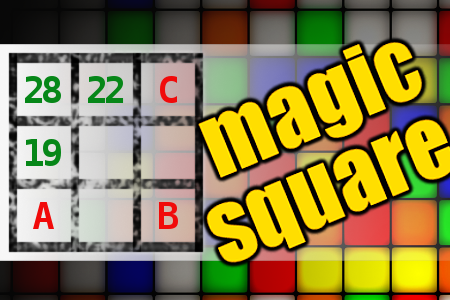
The aim is to place the some numbers from the list (6, 8, 9, 19, 20, 21, 22, 26, 28, 29, 31) into the empty squares and squares marked with A, B an C. Sum of each row and column should be equal. All the numbers of the magic square must be different. Find values for A, B, and C. Solution is A*B+C.
Correct answers: 11
The first user who solved this task is Nasrin 24 T.
#brainteasers #math #magicsquare
Register with your Google Account and start collecting points.
Check your ranking on list.

An elderly retired gentleman h...

An elderly retired gentleman had had severe hearing problems for some time.
He went to the doctor and the doctor was able to have him fitted for a set of hearing aids that allowed the man to hear better than he had ever heard before.
One month later, the elderly man went back again to the doctor. The doctor said, "Your hearing is perfect. Your family must be really pleased that you can hear again."
The gentleman said, "Oh, I haven't told my family yet. I just sit around and listen to the conversations. I've changed my will three times!"
Jokes of the day - Daily updated jokes. New jokes every day.
Follow Brain Teasers on social networks

Brain Teasers

puzzles, riddles, mathematical problems, mastermind, cinemania...

Georg Wittig

Died 26 Aug 1987 at age 90 (born 16 Jun 1897).German chemist whose studies of organic phosphorus compounds won him a share (with Herbert C. Brown) of the Nobel Prize for Chemistry in 1979. In 1953, he discovered how a family of organic compounds called ylides could form the basis of the Wittig reaction, which easily and predictably joins two carbon atoms from different molecules to form a double bond. The Wittig reaction's reliability enabled other chemists to pursue and publish findings on thousands of applications for linking large carbon molecules. The process was used for synthesizing complex compounds such as vitamin A, vitamin D derivatives, steroids, and biological pesticides. Because of the Wittig reaction, such compounds can now routinely be synthesized.
This site uses cookies to store information on your computer. Some are essential to help the site properly. Others give us insight into how the site is used and help us to optimize the user experience. See our privacy policy.