MAGIC SQUARE: Calculate A+B*C
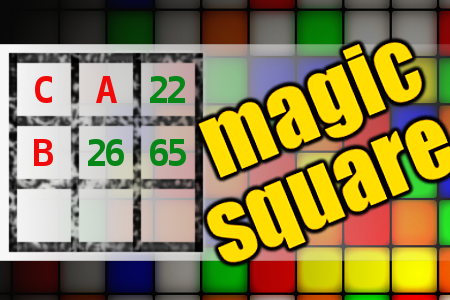
[6938] MAGIC SQUARE: Calculate A+B*C - The aim is to place the some numbers from the list (6, 7, 10, 22, 23, 26, 45, 64, 65, 68) into the empty squares and squares marked with A, B an C. Sum of each row and column should be equal. All the numbers of the magic square must be different. Find values for A, B, and C. Solution is A+B*C. - #brainteasers #math #magicsquare - Correct Answers: 10 - The first user who solved this task is Nasrin 24 T
BRAIN TEASERS
enter your answer and press button OK

MAGIC SQUARE: Calculate A+B*C

The aim is to place the some numbers from the list (6, 7, 10, 22, 23, 26, 45, 64, 65, 68) into the empty squares and squares marked with A, B an C. Sum of each row and column should be equal. All the numbers of the magic square must be different. Find values for A, B, and C. Solution is A+B*C.
Correct answers: 10
The first user who solved this task is Nasrin 24 T.
#brainteasers #math #magicsquare
Register with your Google Account and start collecting points.
Check your ranking on list.

A distraught senior citizen ...

A distraught senior citizen phoned her doctor's office. 'Is it true,' she wanted to know, 'that the medication you prescribed has to be taken for the rest of my life?'
'Yes, I'm afraid so,' the doctor told her.
There was a moment of silence before the senior lady replied, 'I'm wondering, then, just how serious is my condition because this prescription is marked 'NO REFILLS'.'
Jokes of the day - Daily updated jokes. New jokes every day.
Follow Brain Teasers on social networks

Brain Teasers

puzzles, riddles, mathematical problems, mastermind, cinemania...

Mason jar

In 1858, John Landis Mason received a U.S. patent for his invention known by his name - the Mason jar (No. 22,186). Although hundreds of men and women obtained patents for fruit jars, probably the most well known in the industry has been the Mason jar. It has become a common term for the preserved food jar. Mason developed and patented a shoulder-seal jar with a zinc screw cap. The "Mason jar" had a threaded neck which fit with the threads in a metal cap to screw down to the shoulder of the jar and in this way form a seal. In 1869, a top seal above the threads and under a glass lid was introduced to the jar, thus effecting an excellent seal.[Image: The Gem mason jar, made by Hero Glass Works, Philadelphia, Pennsylvania, circa 1869]
This site uses cookies to store information on your computer. Some are essential to help the site properly. Others give us insight into how the site is used and help us to optimize the user experience. See our privacy policy.