MAGIC SQUARE: Calculate A+B-C
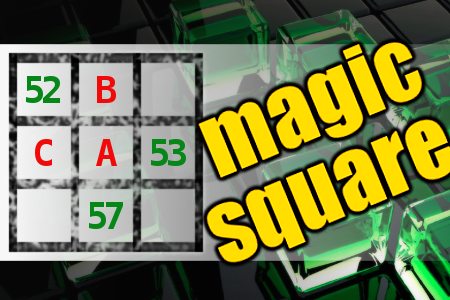
[7105] MAGIC SQUARE: Calculate A+B-C - The aim is to place the some numbers from the list (6, 7, 11, 13, 15, 16, 20, 52, 53, 57) into the empty squares and squares marked with A, B an C. Sum of each row and column should be equal. All the numbers of the magic square must be different. Find values for A, B, and C. Solution is A+B-C. - #brainteasers #math #magicsquare - Correct Answers: 5
BRAIN TEASERS
enter your answer and press button OK

MAGIC SQUARE: Calculate A+B-C

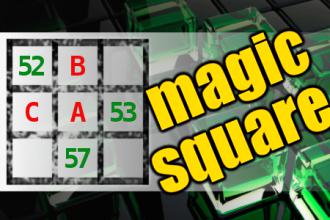
The aim is to place the some numbers from the list (6, 7, 11, 13, 15, 16, 20, 52, 53, 57) into the empty squares and squares marked with A, B an C. Sum of each row and column should be equal. All the numbers of the magic square must be different. Find values for A, B, and C. Solution is A+B-C.
Correct answers: 5
#brainteasers #math #magicsquare
Register with your Google Account and start collecting points.
Check your ranking on list.

 Are You Talking To Me?


At the height of a political corruption trial, the prosecuting attorney attacked a witness. "Isn't it true," he bellowed, "that you accepted five thousand dollars to compromise this case?"
The witness stared out the window, as though he hadn't heard the question.
"Isn't it true that you accepted five thousand dollars to compromise this case?" the lawyer repeated.
The witness still did not respond.
Finally, the judge leaned over and said, "Sir, please answer the question."
"Oh," the startled witness said, "I thought he was talking to you."
Jokes of the day - Daily updated jokes. New jokes every day.
Follow Brain Teasers on social networks

Brain Teasers

puzzles, riddles, mathematical problems, mastermind, cinemania...

Thomas Earnshaw

Died 1 Mar 1829 at age 80 (born 4 Feb 1749).English watchmaker, the first to simplify and economize in producing chronometers so as to make them available to the general public. In 1782, he devised the spring detent chronometer escapement. He did much to develop the chronometer, and was awarded £3,000 by Board of Longitude. His chronometers were described in a publication by the Commissioners of Longitude in 1806. Forty years after his death, the novelist Jules Verne described Phileas Fogg as, "He gave the idea of being perfectly well-balanced, as exactly regulated as a Leroy or Earnshaw chronometer."
This site uses cookies to store information on your computer. Some are essential to help the site properly. Others give us insight into how the site is used and help us to optimize the user experience. See our privacy policy.