MAGIC SQUARE: Calculate A+B-C
[7245] MAGIC SQUARE: Calculate A+B-C - The aim is to place the some numbers from the list (3, 12, 15, 16, 22, 24, 25, 26, 39, 42, 43, 58) into the empty squares and squares marked with A, B an C. Sum of each row and column should be equal. All the numbers of the magic square must be different. Find values for A, B, and C. Solution is A+B-C. - #brainteasers #math #magicsquare - Correct Answers: 3
BRAIN TEASERS
enter your answer and press button OK

MAGIC SQUARE: Calculate A+B-C

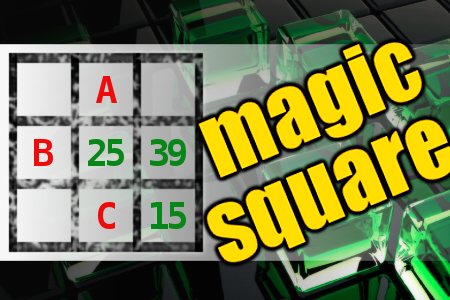
The aim is to place the some numbers from the list (3, 12, 15, 16, 22, 24, 25, 26, 39, 42, 43, 58) into the empty squares and squares marked with A, B an C. Sum of each row and column should be equal. All the numbers of the magic square must be different. Find values for A, B, and C. Solution is A+B-C.
Correct answers: 3
#brainteasers #math #magicsquare
Register with your Google Account and start collecting points.
Check your ranking on list.

Most Useless Inventions


  1. Non stick Cellotape
  2. Solar Powered Flash Light
  3. A black highlighter pen
  4. Glow in the dark sunglasses
  5. Inflatable Anchor
  6. Smooth Sandpaper
  7. Waterproof sponge
  8. Waterproof Teabags
  9. AC adapter for Solar powered calculators
  10. Fireproof Matches
  11. Fireproof Cigarettes
  12. Battery powered Battery Charger
  13. Seatbelts for Motorbikes
  14. Hand powered Chainsaw
  15. Inflatable Dartboard
  16. Silent Alarm Clock
  17. A Pedal powered wheelchair
  18. Braille Drivers Manual
  19. Double sided playing cards
  20. Ejector seats for Helicopters

Jokes of the day - Daily updated jokes. New jokes every day.
Follow Brain Teasers on social networks

Brain Teasers

puzzles, riddles, mathematical problems, mastermind, cinemania...

Franz Joseph Gall

Born 9 Mar 1758; died 22 Aug 1828 at age 70. German physician, anatomist and physiologistt who pioneered in linking cerebral functions to localized areas of the brain and associated with underlying attributes of the human personality. As early as the 1790s, he was developing theories on the anatomy and function of the parts of the brain. He was first to identify recognize that the brain's gray matter was made up of nerve cell bodies, and that the white matter has the fibers that carry impulses from the nerves. He believed an external examination of the skull could reveal individual intellect and personality, which he termed “cranioscopy,” later called “phrenology” by his protegé, Johann G. Spurzheim. In 1805, they travelled on a long lecture tour of Europe, also studying at prisons and asylums.«
This site uses cookies to store information on your computer. Some are essential to help the site properly. Others give us insight into how the site is used and help us to optimize the user experience. See our privacy policy.