
MAGIC SQUARE: Calculate A+B*C
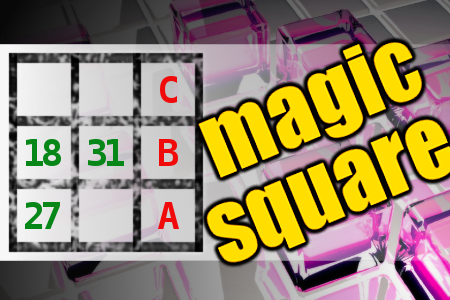
[7252] MAGIC SQUARE: Calculate A+B*C - The aim is to place the some numbers from the list (10, 14, 15, 18, 19, 23, 27, 31, 35, 92) into the empty squares and squares marked with A, B an C. Sum of each row and column should be equal. All the numbers of the magic square must be different. Find values for A, B, and C. Solution is A+B*C. - #brainteasers #math #magicsquare - Correct Answers: 4
BRAIN TEASERS
enter your answer and press button OK

MAGIC SQUARE: Calculate A+B*C

The aim is to place the some numbers from the list (10, 14, 15, 18, 19, 23, 27, 31, 35, 92) into the empty squares and squares marked with A, B an C. Sum of each row and column should be equal. All the numbers of the magic square must be different. Find values for A, B, and C. Solution is A+B*C.
Correct answers: 4
#brainteasers #math #magicsquare
Register with your Google Account and start collecting points.
Check your ranking on list.

My wife and her friend Karen w...

My wife and her friend Karen were talking about their labor-saving devices as they pulled into our driveway. Karen said, “I love my new garage-door opener.”
“I love mine too,” my wife replied, and honked the horn three times. That was the signal for me to come out and open the garage.
Jokes of the day - Daily updated jokes. New jokes every day.
Follow Brain Teasers on social networks

Brain Teasers

puzzles, riddles, mathematical problems, mastermind, cinemania...

Lorenzo Bellini

Born 3 Sep 1643; died 8 Jan 1704 at age 60.Italian physician and anatomist who described the collecting, or excretory, tubules of the kidney, known as Bellini's ducts (tubules). Bellini is considered a founder of Italian iatromechanism, a pioneer in applying mechanical philosophy to the functions of the human body. His early interests were anatomy and physiology. The first essay he published, Exercitatio anatomica de usu renum (1662), contains his anatomical discovery that in the supposedly unorganized parenchyma there is a complicated structure composed of fibers, open spaces, and densely packed tubules opening into the pelvis of the kidney. His further publications extended his effort to explain all important physiological phenomena according to the law of mechanics. (Several discoveries previously ascribed to Lorenzo Bellini were made earlier by Bartolomeo Eustachi.)Image: kidney structure as drawn by Bellini
This site uses cookies to store information on your computer. Some are essential to help the site properly. Others give us insight into how the site is used and help us to optimize the user experience. See our privacy policy.