
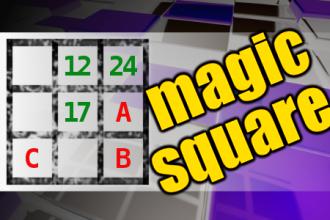
MAGIC SQUARE: Calculate A*B+C
[7358] MAGIC SQUARE: Calculate A*B+C - The aim is to place the some numbers from the list (2, 12, 13, 16, 17, 23, 24, 68, 72, 79, 94) into the empty squares and squares marked with A, B an C. Sum of each row and column should be equal. All the numbers of the magic square must be different. Find values for A, B, and C. Solution is A*B+C. - #brainteasers #math #magicsquare - Correct Answers: 2
BRAIN TEASERS
enter your answer and press button OK

MAGIC SQUARE: Calculate A*B+C

The aim is to place the some numbers from the list (2, 12, 13, 16, 17, 23, 24, 68, 72, 79, 94) into the empty squares and squares marked with A, B an C. Sum of each row and column should be equal. All the numbers of the magic square must be different. Find values for A, B, and C. Solution is A*B+C.
Correct answers: 2
#brainteasers #math #magicsquare
Register with your Google Account and start collecting points.
Check your ranking on list.

Christmas QA jokes part three

Q: What do cats and dogs call Santa Clause?
A: Santa paws!!!

Q: What is a parents favorite Christmas carol?
A: Silent night!

Q: What do you get from a cow at the North Pole?
A: Ice cream.

Q: Why do mummys like the holidays?
A: Becuse of all the wrapping!

Q: Why don’t aliens celebrate Chistmas?
A: Because they don’t want to give away their presence.

Q: When does New Year’s Day come before Christmas Day?
A: Every year!

Q: Why does everybody like Frosty the Snowman?
A: Because he is so cool!

Q.Which reindeer likes to clean?
A.Comet

Jokes of the day - Daily updated jokes. New jokes every day.
Follow Brain Teasers on social networks

Brain Teasers

puzzles, riddles, mathematical problems, mastermind, cinemania...

James David Forbes

Died 31 Dec 1868 at age 59 (born 20 Apr 1809).Scottish physicist noted for his research on heat conduction and glaciers. In 1836-44, he described the polarization (alignment of waves to vibrate in a plane) of radiant infrared heat by the mineral tourmaline, by transmission through a bundle of thin mica plates, and by reflection from the surfaces of a pile of mica plates. In 1846 he began experiments on the temperature of the Earth at different depths and in different soils near Edinburgh. Later he investigated the laws of heat conduction in bars, and in his last piece of work reported that iron conducts heat less efficiently as its temperature rises. He was among the first to study glacier movements and was involved with Tyndall in the great glacier controversy of the 1850s.
This site uses cookies to store information on your computer. Some are essential to help the site properly. Others give us insight into how the site is used and help us to optimize the user experience. See our privacy policy.