
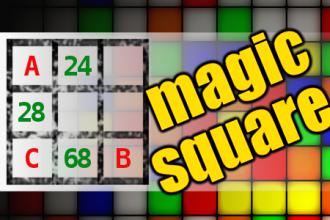
MAGIC SQUARE: Calculate A+B+C
[7392] MAGIC SQUARE: Calculate A+B+C - The aim is to place the some numbers from the list (16, 19, 20, 24, 27, 28, 64, 67, 68, 87, 93) into the empty squares and squares marked with A, B an C. Sum of each row and column should be equal. All the numbers of the magic square must be different. Find values for A, B, and C. Solution is A+B+C. - #brainteasers #math #magicsquare - Correct Answers: 2
BRAIN TEASERS
enter your answer and press button OK

MAGIC SQUARE: Calculate A+B+C

The aim is to place the some numbers from the list (16, 19, 20, 24, 27, 28, 64, 67, 68, 87, 93) into the empty squares and squares marked with A, B an C. Sum of each row and column should be equal. All the numbers of the magic square must be different. Find values for A, B, and C. Solution is A+B+C.
Correct answers: 2
#brainteasers #math #magicsquare
Register with your Google Account and start collecting points.
Check your ranking on list.

A professor of chemistry wante...

A professor of chemistry wanted to teach his 5th grade class a lesson about the evils of alcohol, so he produced an experiment that involved a glass of water, a glass of whiskey and two worms."Now, class. Observe closely the worms," said the professor putting a worm first into the water. The worm in the water writhed about, happy as a worm in water could be.
The second worm, he put into the whiskey. It writhed painfully, and quickly sank to the bottom, dead as a doornail.
"Now, what lesson can we derive from this experiment?" the professor asked.
Little Johnny, who naturally sits in back, raised his hand and wisely, responded...
"Drink whiskey and you won't get worms!"
Jokes of the day - Daily updated jokes. New jokes every day.
Follow Brain Teasers on social networks

Brain Teasers

puzzles, riddles, mathematical problems, mastermind, cinemania...

Frederick Walton

Died 16 May 1928 at age 94 (born 13 Mar 1834).English inventor who invented linoleum (pat. app. 19 Dec 1863, No. 3210). His 88 patents included artificial leather, distillation, plastics, flexible metal tubing, and Lincrusta, an embossed linoleum wall covering (1877). He was a self-described “practical utilitarian of the nineteenth century,” with no education in chemistry or engineering. Before linoleum, he patented (Sep 1861) a varnish applicable to the waterproofing and coating of fabrics. In Jan 1862 he applied with his brother for a patent in which textile card brushes had the short wire bristles held in an india rubber backing. Walton started in the family business of processing India rubber. He developed linoleum from observing the plastic dried surface layer of linseed oil-based paint, which he first investigated as an alternative to rubber and led to linoleum.«
This site uses cookies to store information on your computer. Some are essential to help the site properly. Others give us insight into how the site is used and help us to optimize the user experience. See our privacy policy.