MAGIC SQUARE: Calculate A*B+C
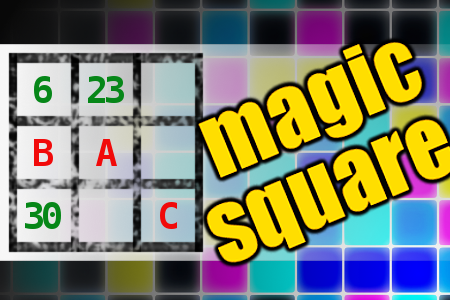
[7447] MAGIC SQUARE: Calculate A*B+C - The aim is to place the some numbers from the list (5, 6, 15, 23, 24, 30, 31, 33, 40, 47) into the empty squares and squares marked with A, B an C. Sum of each row and column should be equal. All the numbers of the magic square must be different. Find values for A, B, and C. Solution is A*B+C. - #brainteasers #math #magicsquare - Correct Answers: 4
BRAIN TEASERS
enter your answer and press button OK

MAGIC SQUARE: Calculate A*B+C

The aim is to place the some numbers from the list (5, 6, 15, 23, 24, 30, 31, 33, 40, 47) into the empty squares and squares marked with A, B an C. Sum of each row and column should be equal. All the numbers of the magic square must be different. Find values for A, B, and C. Solution is A*B+C.
Correct answers: 4
#brainteasers #math #magicsquare

Register with your Google Account and start collecting points.
Check your ranking on list.

Three leaders of the big beer ...

Three leaders of the big beer companies meet for a drink. The president of Budweiser orders a Bud. Miller's president orders a Millers and the president of Coors orders a Coors. When it is Guinness turn to order he orders a soda. Why didn't you order a Guinness everyone asks? Nah Guinness replies. If you guys aren't having a beer neither will I.
Jokes of the day - Daily updated jokes. New jokes every day.
Follow Brain Teasers on social networks

Brain Teasers

puzzles, riddles, mathematical problems, mastermind, cinemania...

Charles Martin Hall

Born 6 Dec 1863; died 27 Dec 1914 at age 51.American chemist who invented the inexpensive electrolytic method of extracting aluminium from its ore, enabling the wide commercial use of this metal. While a young chemist, he experimented in a woodshed, intent upon finding a method for separating aluminum from its ore. At first, he was unsuccessful, but then realized that he needed a nonaqueous solvent for the aluminum oxide during electrolysis. On 23 Feb 1886, Hall found that molten cryolite (the mineral sodium aluminum fluoride) was a suitable solvent and using carbon electrodes with home-made batteries, he produced his first small globules of aluminum. By 1914, Hall's process had brought the cost of aluminium, once a precious metal used for fine jewelry, down to 18 cents a pound.«
This site uses cookies to store information on your computer. Some are essential to help the site properly. Others give us insight into how the site is used and help us to optimize the user experience. See our privacy policy.