MAGIC SQUARE: Calculate A-B-C
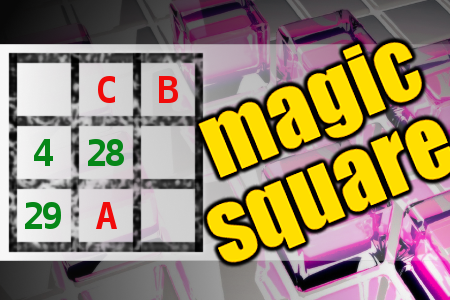
[7496] MAGIC SQUARE: Calculate A-B-C - The aim is to place the some numbers from the list (4, 6, 7, 16, 26, 28, 29, 40, 47, 49, 50) into the empty squares and squares marked with A, B an C. Sum of each row and column should be equal. All the numbers of the magic square must be different. Find values for A, B, and C. Solution is A-B-C. - #brainteasers #math #magicsquare - Correct Answers: 1
BRAIN TEASERS
enter your answer and press button OK

MAGIC SQUARE: Calculate A-B-C

The aim is to place the some numbers from the list (4, 6, 7, 16, 26, 28, 29, 40, 47, 49, 50) into the empty squares and squares marked with A, B an C. Sum of each row and column should be equal. All the numbers of the magic square must be different. Find values for A, B, and C. Solution is A-B-C.
Correct answers: 1
#brainteasers #math #magicsquare
Register with your Google Account and start collecting points.
Check your ranking on list.

Gabriel Iglesias: The Only Big Friend Argument

When you have nothing but big friends, you never get into arguments -- except one. And that is, who is the biggest? Ill let you know right now, theres only one way to settle this. We all get in a bus and we go to Disney and we get on a roller coaster -- whoever gets the least amount of clicks on the safety bar is the big one.
Jokes of the day - Daily updated jokes. New jokes every day.
Follow Brain Teasers on social networks

Brain Teasers

puzzles, riddles, mathematical problems, mastermind, cinemania...

Edison patent

In 1922, Thomas A. Edison was issued a U.S. patent for a "Storage-Battery Electrode and the Production of Same" (No. 1402751). The electrodes were intended for batteries of the Edison type using nickel hydroxide for the active material for the positive elements and electrolytically active iron as the active material for the negative elements in an alkaline solution. The improved electrode element was designed to provide a high discharge rate by decreasing the internal resistance of the cell. The electrode element consisted of a thin metallic plate with small and closely adjacent perforations. The metal surface had a thin coating or film of a hydroxideof a suitable metal (preferable nickel) applied by electrolytic deposition.«[Image: one of the patent diagrams showing a fragmental sectional view of the electrode element.]
This site uses cookies to store information on your computer. Some are essential to help the site properly. Others give us insight into how the site is used and help us to optimize the user experience. See our privacy policy.