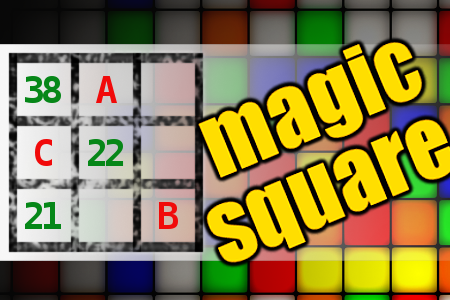
MAGIC SQUARE: Calculate A-B-C
[7552] MAGIC SQUARE: Calculate A-B-C - The aim is to place the some numbers from the list (13, 14, 16, 21, 22, 24, 37, 38, 40, 90, 91, 98) into the empty squares and squares marked with A, B an C. Sum of each row and column should be equal. All the numbers of the magic square must be different. Find values for A, B, and C. Solution is A-B-C. - #brainteasers #math #magicsquare - Correct Answers: 1
BRAIN TEASERS
enter your answer and press button OK

MAGIC SQUARE: Calculate A-B-C

The aim is to place the some numbers from the list (13, 14, 16, 21, 22, 24, 37, 38, 40, 90, 91, 98) into the empty squares and squares marked with A, B an C. Sum of each row and column should be equal. All the numbers of the magic square must be different. Find values for A, B, and C. Solution is A-B-C.
Correct answers: 1
#brainteasers #math #magicsquare
Register with your Google Account and start collecting points.
Check your ranking on list.

Rolling Her Eyes

Two monsters went to a Halloween party. Suddenly one said to the other, "A lady just rolled her eyes at me. What should I do?"
The other monster replied, "Be a gentleman and roll them back to her."

Jokes of the day - Daily updated jokes. New jokes every day.
Follow Brain Teasers on social networks

Brain Teasers

puzzles, riddles, mathematical problems, mastermind, cinemania...

Fluoridation

In 1967, the first fluoridation law in the U.S. went into effect in Connecticut, requiring fluoridation of public water supplies serving 20,000 or more population, to prevent dental caries. The water fluoridation era began in 1945 when the cities of Newburgh, New York, and Grand Rapids, Michigan, began adding sodium fluoride to their public water systems. This followed the work done (1930-1943) by Frederick S. McKay, a Colorado dentist, who related brown stains (mottling) on his patients' teeth to low dental caries due to the source of their drinking water containing high levels of naturally occurring fluoride. By the early 1940s, H. Trendley Dean had determined the ideal level of fluoride in drinking water to reduce decay without mottling.
This site uses cookies to store information on your computer. Some are essential to help the site properly. Others give us insight into how the site is used and help us to optimize the user experience. See our privacy policy.