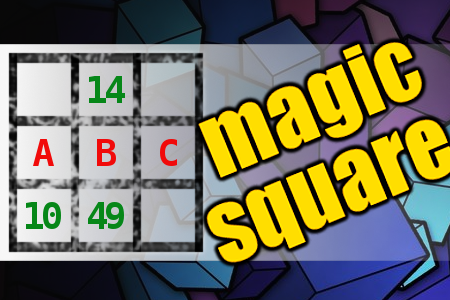
MAGIC SQUARE: Calculate A+B+C
[7677] MAGIC SQUARE: Calculate A+B+C - The aim is to place the some numbers from the list (9, 10, 13, 14, 20, 24, 38, 39, 49, 80, 97) into the empty squares and squares marked with A, B an C. Sum of each row and column should be equal. All the numbers of the magic square must be different. Find values for A, B, and C. Solution is A+B+C. - #brainteasers #math #magicsquare - Correct Answers: 1
BRAIN TEASERS
enter your answer and press button OK

MAGIC SQUARE: Calculate A+B+C

The aim is to place the some numbers from the list (9, 10, 13, 14, 20, 24, 38, 39, 49, 80, 97) into the empty squares and squares marked with A, B an C. Sum of each row and column should be equal. All the numbers of the magic square must be different. Find values for A, B, and C. Solution is A+B+C.
Correct answers: 1
#brainteasers #math #magicsquare

Register with your Google Account and start collecting points.
Check your ranking on list.

Two old married men chatting i...

Two old married men chatting in a bar.
First man says, "Have you ever thought that marriage was a bit of a lottery?"
The second man replied, "Not at all. At least you have a slight chance with a lottery."
Jokes of the day - Daily updated jokes. New jokes every day.
Follow Brain Teasers on social networks

Brain Teasers

puzzles, riddles, mathematical problems, mastermind, cinemania...

Alan Baker

Born 19 Aug 1939.British mathematician who was awarded the Fields Medal in 1970. Awarded every four years for outstanding discoveries in mathematics, the Medal is considered the highest honor in the field and the equivalent of the Nobel Prize. This award was for his work in Transcendental Number Theory. From ancient Greek times, people tried to 'square a circle' (create a square with the same area as a circle using a ruler and compasses only), but it proved impossible last century by showing that pi is a transcendental number (a number which is not a solution of a polynomial equation with integer coefficients). Baker's work here was a breakthrough with diophantine equations. Baker also made substantial contributions to Hilbert's seventh problem.
This site uses cookies to store information on your computer. Some are essential to help the site properly. Others give us insight into how the site is used and help us to optimize the user experience. See our privacy policy.