
MAGIC SQUARE: Calculate A+B*C
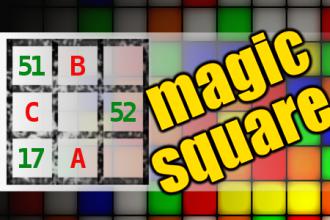
[7705] MAGIC SQUARE: Calculate A+B*C - The aim is to place the some numbers from the list (6, 16, 17, 18, 19, 24, 26, 37, 51, 52, 59, 99) into the empty squares and squares marked with A, B an C. Sum of each row and column should be equal. All the numbers of the magic square must be different. Find values for A, B, and C. Solution is A+B*C. - #brainteasers #math #magicsquare - Correct Answers: 3
BRAIN TEASERS
enter your answer and press button OK

MAGIC SQUARE: Calculate A+B*C

The aim is to place the some numbers from the list (6, 16, 17, 18, 19, 24, 26, 37, 51, 52, 59, 99) into the empty squares and squares marked with A, B an C. Sum of each row and column should be equal. All the numbers of the magic square must be different. Find values for A, B, and C. Solution is A+B*C.
Correct answers: 3
#brainteasers #math #magicsquare
Register with your Google Account and start collecting points.
Check your ranking on list.

Peanuts

A tour bus driver is driving with a bus load of seniors down a highway when he is tapped on his shoulder by a little old lady. She offers him a handful of peanuts, which he gratefully munches up. After about 15 minutes, she taps him on his shoulder again and she hands him another handful of peanuts. She repeats this gesture about five more times. When she is about to hand him another batch again he asks the little old lady, " Why then don't you eat the peanuts yourself?".
"We can't chew them because we've no teeth," she replied.
The puzzled driver asks, "Why do you buy them then?"
The old lady replied, "We just love the chocolate around them."  

Jokes of the day - Daily updated jokes. New jokes every day.
Follow Brain Teasers on social networks

Brain Teasers

puzzles, riddles, mathematical problems, mastermind, cinemania...

Liquifaction of oxygen

In 1879, the liquefaction of oxygen was announced by Raoul Pierre Pictet (1846-1929), a Swiss chemist and physicist, by sending a telegram to the French Academy: Oxygen liquefied today under 320-atm and 140 degrees of cold by combined use of sulfurous and carbonic acid. French physicist Louis Cailletet made a similar announcement two days later. Pictet's early interest was in ice-making machines. Later, he studied extremely low temperatures and the liquefaction of gases. Both Pictet and Cailletet used both cooling and compression to liquefy oxygen but they achieved this using different techniques. Pictet's method had an advantage in that produced the liquid gas in greater quantity and was easier to apply to other gases.[Image: part of a Pictet machine to cool down glycerine, which was pumped through a piping system in the first artificial skating track:]
This site uses cookies to store information on your computer. Some are essential to help the site properly. Others give us insight into how the site is used and help us to optimize the user experience. See our privacy policy.