MAGIC SQUARE: Calculate A-B+C
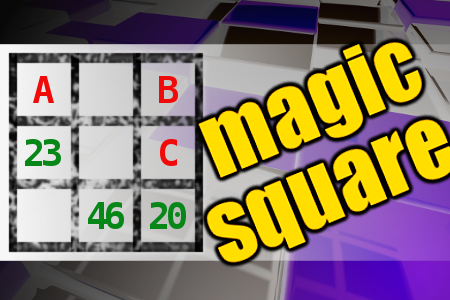
[7753] MAGIC SQUARE: Calculate A-B+C - The aim is to place the some numbers from the list (1, 18, 20, 23, 27, 29, 32, 39, 41, 43, 46, 74) into the empty squares and squares marked with A, B an C. Sum of each row and column should be equal. All the numbers of the magic square must be different. Find values for A, B, and C. Solution is A-B+C. - #brainteasers #math #magicsquare - Correct Answers: 1
BRAIN TEASERS
enter your answer and press button OK

MAGIC SQUARE: Calculate A-B+C

The aim is to place the some numbers from the list (1, 18, 20, 23, 27, 29, 32, 39, 41, 43, 46, 74) into the empty squares and squares marked with A, B an C. Sum of each row and column should be equal. All the numbers of the magic square must be different. Find values for A, B, and C. Solution is A-B+C.
Correct answers: 1
#brainteasers #math #magicsquare
Register with your Google Account and start collecting points.
Check your ranking on list.

Sandpaper

Pinocchio is all grown up, and has moved out. One day, he meets Gepetto in a bar, and starts confiding in him.

"Whenever I'm having sex with a girl, she complains about splinters." he says.

Gepetto looks all wise, and tells him that whenever he feels 'lucky', he should rub sandpaper on his 'member'.

Happy, Pinocchio says he'll try it.

A few weeks later, Gepetto spots Pinocchio walking down the street, he stops him, and asks how its going with the girls, now, to which Pinocchio replies, "Hey, who needs girls?"

Submitted by Calamjo

Edited by Curtis

Jokes of the day - Daily updated jokes. New jokes every day.
Follow Brain Teasers on social networks

Brain Teasers

puzzles, riddles, mathematical problems, mastermind, cinemania...

Kurt Koffka

Born 18 Mar 1886; died 22 Nov 1941 at age 55. German-American psychologist who co-founded, with Wolfgang Köhler and Max Wertheimer, the Gestalt school of psychology. Koffka became in time their most influential spokesman of Gestalt psychology. He applied it to child development, learning, memory and emotion. The name Gestalt, meaning form or configuration, emphasizes that the whole is more than the sum of its parts. Gestalt psychology grew as reaction against the traditional atomistic approach to the human being where behaviour was analyzed into constituent elements called sensations. He made an influential distinction between the behavioural and the geographical environments - the perceived world of common sense and the world studied by scientists.
This site uses cookies to store information on your computer. Some are essential to help the site properly. Others give us insight into how the site is used and help us to optimize the user experience. See our privacy policy.