MAGIC SQUARE: Calculate A-B-C
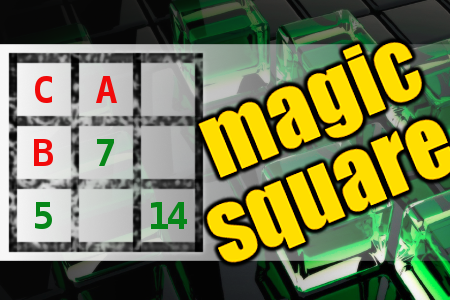
[7843] MAGIC SQUARE: Calculate A-B-C - The aim is to place the some numbers from the list (5, 7, 9, 12, 14, 16, 27, 29, 31, 59, 89) into the empty squares and squares marked with A, B an C. Sum of each row and column should be equal. All the numbers of the magic square must be different. Find values for A, B, and C. Solution is A-B-C. - #brainteasers #math #magicsquare - Correct Answers: 1
BRAIN TEASERS
enter your answer and press button OK

MAGIC SQUARE: Calculate A-B-C

The aim is to place the some numbers from the list (5, 7, 9, 12, 14, 16, 27, 29, 31, 59, 89) into the empty squares and squares marked with A, B an C. Sum of each row and column should be equal. All the numbers of the magic square must be different. Find values for A, B, and C. Solution is A-B-C.
Correct answers: 1
#brainteasers #math #magicsquare
Register with your Google Account and start collecting points.
Check your ranking on list.

A doctor and a lawyer were att...

A doctor and a lawyer were attending a cocktail party when the doctor was approached by a man who asked advice on how to handle his ulcer. The doctor mumbled some medical advice, then turned to the lawyer and remarked, 'I never know how to handle the situation when I'm asked for medical advice during a social function. Is it acceptable to send a bill for such advice?'

The lawyer replied that it was certainly acceptable to do so.

The next day, the doctor sent the ulcer-stricken man a bill. The lawyer also sent one to the doctor.
Jokes of the day - Daily updated jokes. New jokes every day.
Follow Brain Teasers on social networks

Brain Teasers

puzzles, riddles, mathematical problems, mastermind, cinemania...

Johann Palisa

Born 6 Dec 1848; died 2 May 1925 at age 76.Austrian astronomer who was a prolific discoverer of asteroids, 122 in all, beginning with Asteroid 136 Austria (on 18 Mar 1874, using a 6" refractor) to Asteroid 1073 Gellivara in 1923 - all by visual observation, without the aid of photography. In 1883, he joined the expedition of the French academy to observe the total solar eclipse on May 6 of that year. During the eclipse, he searched for the putative planet Vulcan, which was supposed to circle the sun within the orbit of Mercury. In addition to observing the eclipse, Palisa collected insects for the Natural History Museum in Vienna. He also prepared two catalogs containing the positions of almost 4,700 stars. He remains the most successful visual discoverer in the history of minor planet research.«
This site uses cookies to store information on your computer. Some are essential to help the site properly. Others give us insight into how the site is used and help us to optimize the user experience. See our privacy policy.