
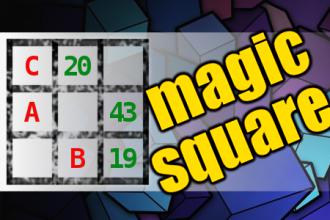
MAGIC SQUARE: Calculate A*B*C
[7940] MAGIC SQUARE: Calculate A*B*C - The aim is to place the some numbers from the list (3, 4, 11, 19, 20, 27, 42, 43, 50, 90) into the empty squares and squares marked with A, B an C. Sum of each row and column should be equal. All the numbers of the magic square must be different. Find values for A, B, and C. Solution is A*B*C. - #brainteasers #math #magicsquare - Correct Answers: 0
BRAIN TEASERS
enter your answer and press button OK

MAGIC SQUARE: Calculate A*B*C

The aim is to place the some numbers from the list (3, 4, 11, 19, 20, 27, 42, 43, 50, 90) into the empty squares and squares marked with A, B an C. Sum of each row and column should be equal. All the numbers of the magic square must be different. Find values for A, B, and C. Solution is A*B*C.
Correct answers: 0
#brainteasers #math #magicsquare
Register with your Google Account and start collecting points.
Check your ranking on list.

International Day for Monuments and Sites/World Heritage Day jokes

Today is International Day for Monuments and Sites (World Heritage Day)! Find a joke about it!

Why the great pyramids are in Egypt?
Because they were too heavy to carry of to the British museum.

Why was Cleopatra angry?
She was on her pyramid.

I was offered a job building Egyptian tombs
Turned out to be a pyramid scheme

I'm surprised the tower of Pisa hasn't fallen over during the pandemic
Without all those tourists helping hold it up.

Two Americans are visiting Rome Colosseum
"Look at it. How huge and majestic it is."
"Just imagine how great it'll be when they finish building it."

Jokes of the day - Daily updated jokes. New jokes every day.
Follow Brain Teasers on social networks

Brain Teasers

puzzles, riddles, mathematical problems, mastermind, cinemania...

Karl Dussik

Born 9 Jan 1908; died 19 Mar 1968 at age 60.Karl (Theodore) Dussik was an Austrian neurologist and psychiatrist who has been called the "Father of Ultrasonic Diagnosis". In 1942, he published the first transmission ultrasound investigation of the brain Hyperphonography of the Brain, which he used to image a cerebral ventrical. He placing a patient's head between an ultrasound emitter and a receiver. In this way, he tried to visualize the cerebral ventricles by measuring the ultrasound beam modification through the head. However, the bone of the skull absorbed much of the ultrasound energy, and the image created by different bone thickness obscured any reliable image of the brain alone. However, his work with transmitted ultrasound stimulated the use of reflection techniques.«
This site uses cookies to store information on your computer. Some are essential to help the site properly. Others give us insight into how the site is used and help us to optimize the user experience. See our privacy policy.