MAGIC SQUARE: Calculate A+B+C
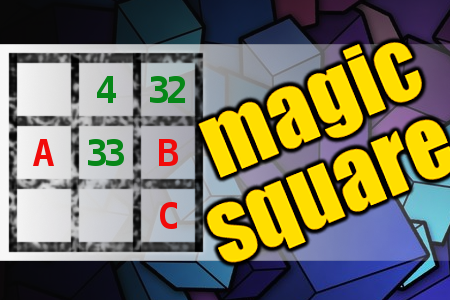
[7989] MAGIC SQUARE: Calculate A+B+C - The aim is to place the some numbers from the list (4, 8, 9, 28, 32, 33, 42, 46, 47, 62, 98) into the empty squares and squares marked with A, B an C. Sum of each row and column should be equal. All the numbers of the magic square must be different. Find values for A, B, and C. Solution is A+B+C. - #brainteasers #math #magicsquare - Correct Answers: 0
BRAIN TEASERS
enter your answer and press button OK

MAGIC SQUARE: Calculate A+B+C

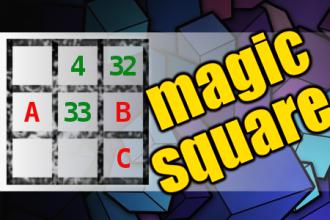
The aim is to place the some numbers from the list (4, 8, 9, 28, 32, 33, 42, 46, 47, 62, 98) into the empty squares and squares marked with A, B an C. Sum of each row and column should be equal. All the numbers of the magic square must be different. Find values for A, B, and C. Solution is A+B+C.
Correct answers: 0
#brainteasers #math #magicsquare
Register with your Google Account and start collecting points.
Check your ranking on list.

Bad news or terrible news

This guy was sitting in his attorney's office. "Do you want the bad news first or the terrible news?" the lawyer said.

"Give me the bad news first."

"Your wife found a picture worth a half-million dollars."

"That's the bad news?" asked the man incredulously. "I can't wait to hear the terrible news."

"The terrible news is that it's of you and your secretary."

Jokes of the day - Daily updated jokes. New jokes every day.
Follow Brain Teasers on social networks

Brain Teasers

puzzles, riddles, mathematical problems, mastermind, cinemania...

Edward Daniel Clarke

Born 5 Jun 1769; died 9 Mar 1822 at age 52.English mineralogist and traveller who amassed a valuable collection of minerals. In 1799, he began a 3-year tour through Asia Minor, Italy, Greece, Scandinavia and Siberia, where he also collected maps, statues and sarcophagi, manuscripts, and Greek coins. He was the first professor of mineralogy at Cambridge University (1808). In 1817 he became librarian there, until his health failed, though he continued to lecture until 1821. He had a significant impact through his teaching of minerology in terms of crystallography and the new chemistry, and through the topological geology and volcanological observations in his widely read Travels (6 vols. 1810-23). His mineral collection was bought by Cambridge at his death for 1,500 pounds.
This site uses cookies to store information on your computer. Some are essential to help the site properly. Others give us insight into how the site is used and help us to optimize the user experience. See our privacy policy.