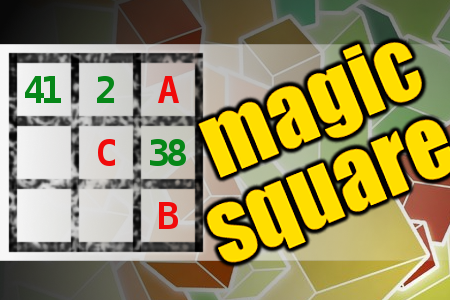
MAGIC SQUARE: Calculate A*B+C
[8136] MAGIC SQUARE: Calculate A*B+C - The aim is to place the some numbers from the list (2, 4, 5, 6, 8, 9, 14, 38, 40, 41, 62) into the empty squares and squares marked with A, B an C. Sum of each row and column should be equal. All the numbers of the magic square must be different. Find values for A, B, and C. Solution is A*B+C. - #brainteasers #math #magicsquare - Correct Answers: 0
BRAIN TEASERS
enter your answer and press button OK

MAGIC SQUARE: Calculate A*B+C

The aim is to place the some numbers from the list (2, 4, 5, 6, 8, 9, 14, 38, 40, 41, 62) into the empty squares and squares marked with A, B an C. Sum of each row and column should be equal. All the numbers of the magic square must be different. Find values for A, B, and C. Solution is A*B+C.
Correct answers: 0
#brainteasers #math #magicsquare
Register with your Google Account and start collecting points.
Check your ranking on list.

Fish trap

This fisherman goes to the river to check an illegal fish trap that he owns. He looks around to make sure there are no Fishing Inspectors about and proceeds to pull the fish trap out to check it.

An Inspector steps out of the bushes, “Ahha!” he said and the fisherman spun around and yelled “Shiiiit!”. The Inspector, who wasn’t expecting such a response said “Settle down, I’m the Fishing Inspector”.

“Thank God for that” said the fisherman, “I thought you were the bugger who owned this fish trap”.

Jokes of the day - Daily updated jokes. New jokes every day.
Follow Brain Teasers on social networks

Brain Teasers

puzzles, riddles, mathematical problems, mastermind, cinemania...

Mikhail Semyonovich Tswett

Born 14 May 1872; died 26 Jun 1919 at age 47.Russian botanist, the “father of chromatography,” who developed and named the adsorption chromatography technique of separating plant pigments by extracting them from leaves with ether and alcohol and percolating the solution through a column of calcium carbonate. The components of the mixture moved at different rates, producing a series of bands. He is known in particular for his study of the chlorophylls and the carotenoids. However, in Tswett's own lifetime, chromatography remained virtually unrecognized as a scientific tool. In the 1930s, it was rediscovered and then spread worldwide. The chromatography technique he invented is now widely used to separate substances from mixtures. (Also spelled Tsvet.)
This site uses cookies to store information on your computer. Some are essential to help the site properly. Others give us insight into how the site is used and help us to optimize the user experience. See our privacy policy.