MAGIC SQUARE: Calculate A-B-C
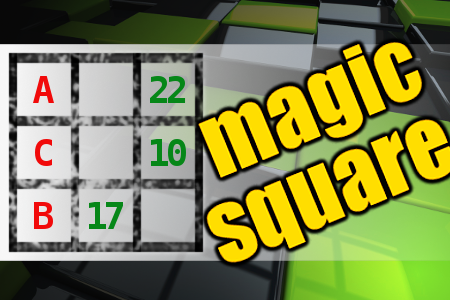
[8227] MAGIC SQUARE: Calculate A-B-C - The aim is to place the some numbers from the list (2, 4, 8, 10, 11, 13, 15, 17, 22, 30, 36) into the empty squares and squares marked with A, B an C. Sum of each row and column should be equal. All the numbers of the magic square must be different. Find values for A, B, and C. Solution is A-B-C. - #brainteasers #math #magicsquare - Correct Answers: 0
BRAIN TEASERS
enter your answer and press button OK

MAGIC SQUARE: Calculate A-B-C

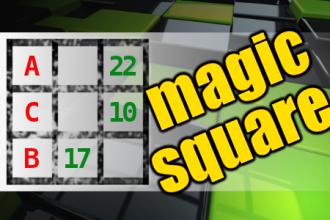
The aim is to place the some numbers from the list (2, 4, 8, 10, 11, 13, 15, 17, 22, 30, 36) into the empty squares and squares marked with A, B an C. Sum of each row and column should be equal. All the numbers of the magic square must be different. Find values for A, B, and C. Solution is A-B-C.
Correct answers: 0
#brainteasers #math #magicsquare
Register with your Google Account and start collecting points.
Check your ranking on list.

Teaching Maths

Q:how do you teach a blonde maths

A: Add a bed, minus her clothes, divide her legs, insert your square route, leave your solution and hope she doesnt multiply.

Jokes of the day - Daily updated jokes. New jokes every day.
Follow Brain Teasers on social networks

Brain Teasers

puzzles, riddles, mathematical problems, mastermind, cinemania...

Abraham Pais

Born 19 May 1918; died 28 Jul 2000 at age 82. Dutch-American physicist and science historian whose research became the building blocks of the theory of elemental particles. He wrote Subtle Is the Lord: The Science and Life of Albert Einstein, which is considered the definitive Einstein biography. In Holland, his Ph.D. in physics was awarded on 9 Jul 1941, five days before a Nazi deadline banning Jews from receiving degrees. Later, during WW II, while in hiding to evade the Gestapo, he worked out ideas in quantum electrodynamics that he later shared when working with Niels Bohr (Jan - Aug 1946). In Sep 1946, he went to the U.S. to work with Robert Oppenheimer at Princeton, where Pais contributed to the foundations of the modern theory of particle physics.
This site uses cookies to store information on your computer. Some are essential to help the site properly. Others give us insight into how the site is used and help us to optimize the user experience. See our privacy policy.