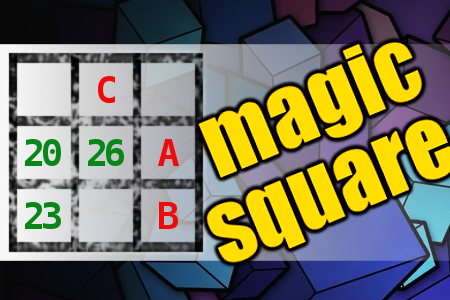
MAGIC SQUARE: Calculate A*B+C
[8565] MAGIC SQUARE: Calculate A*B+C - The aim is to place the some numbers from the list (13, 16, 20, 22, 23, 25, 26, 29, 30, 62, 92) into the empty squares and squares marked with A, B an C. Sum of each row and column should be equal. All the numbers of the magic square must be different. Find values for A, B, and C. Solution is A*B+C. - #brainteasers #math #magicsquare - Correct Answers: 0
BRAIN TEASERS
enter your answer and press button OK

MAGIC SQUARE: Calculate A*B+C

The aim is to place the some numbers from the list (13, 16, 20, 22, 23, 25, 26, 29, 30, 62, 92) into the empty squares and squares marked with A, B an C. Sum of each row and column should be equal. All the numbers of the magic square must be different. Find values for A, B, and C. Solution is A*B+C.
Correct answers: 0
#brainteasers #math #magicsquare
Register with your Google Account and start collecting points.
Check your ranking on list.

Caramel Jokes

Today is National National Caramel Day (USA). Have a Caramel, or few!

My girlfriend likes to tie me to the bed and cover me in chocolate and caramel
She's a dominatwix

I like my women how I like my coffee.
Medium cold, French Vanilla and Caramel Swirl, Regular.

How did the hipster burn his mouth?
He took a sip of his venti caramel latte before it was cool

My next door neighbour is an ice cream man, he went missing and we eventually found him in the back of his van covered in sprinkles, caramel, crushed oreos, and chocolate flakes
Apparently he topped himself!

Jokes of the day - Daily updated jokes. New jokes every day.
Follow Brain Teasers on social networks

Brain Teasers

puzzles, riddles, mathematical problems, mastermind, cinemania...

First eclipse photo

In 1851, a total solar eclipse was first captured on a daguerreotype photograph by Busch and Berkowski, at the Royal Observatory in Königsberg, Prussia (now Kalinigrad in Russia). It showed a slight but distinct impression of the corona duringthe total eclipse. Berkowski, a local daguerrotypist whose first name was never published, observed at the Royal Observatory. A small 6-cm refracting telescope was attached to a 15.8-cm Fraunhofer heliometer and a 84-second exposure was taken shortly after the beginning of totality.«[Image: Fraunhoffer heliometer at the Royal Observatory of Königsberg c. 1851 which was used to make first photograph of a total solar eclipse.]
This site uses cookies to store information on your computer. Some are essential to help the site properly. Others give us insight into how the site is used and help us to optimize the user experience. See our privacy policy.