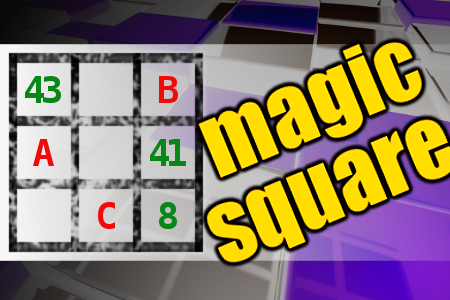
MAGIC SQUARE: Calculate A*B+C
[1650] MAGIC SQUARE: Calculate A*B+C - The aim is to place the some numbers from the list (3, 6, 8, 17, 19, 29, 31, 40, 41, 43, 52, 54, 93) into the empty squares and squares marked with A, B an C. Sum of each row and column should be equal. All the numbers of the magic square must be different. Find values for A, B, and C. Solution is A*B+C. - #brainteasers #math #magicsquare - Correct Answers: 30 - The first user who solved this task is Sanja Šabović
BRAIN TEASERS
enter your answer and press button OK

MAGIC SQUARE: Calculate A*B+C

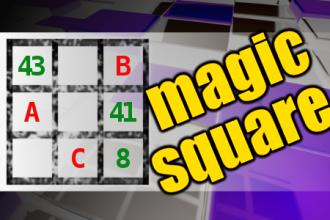
The aim is to place the some numbers from the list (3, 6, 8, 17, 19, 29, 31, 40, 41, 43, 52, 54, 93) into the empty squares and squares marked with A, B an C. Sum of each row and column should be equal. All the numbers of the magic square must be different. Find values for A, B, and C. Solution is A*B+C.
Correct answers: 30
The first user who solved this task is Sanja Šabović.
#brainteasers #math #magicsquare
Register with your Google Account and start collecting points.
Check your ranking on list.

Stung by a bee

A woman taking golf lessons had just started her first round when she was stung by a bee. Distraught, she went back into the clubhouse and told her golf teacher about the incident.

"Where did it sting you?" he asked.

"Between the first and second hole," she replied.

He shook his head and said: "That's your problem right there. You had your feet too far apart!"

Jokes of the day - Daily updated jokes. New jokes every day.
Follow Brain Teasers on social networks

Brain Teasers

puzzles, riddles, mathematical problems, mastermind, cinemania...

Augustin Jean Fresnel

Died 14 Jul 1827 at age 39 (born 10 May 1788).French physicist who first investigated the effect of interference of light, with results known as Fresnel fringes. This decisive work, together with further experiments with polarized light, supported Thomas Young's wave theory of light. Fresnel advanced the wave theory by identifying light as transverse waves rather than the longitudinal waves previously assumed by Young and Christiaan Huygens. His pioneering work in optics included showing that white light is composed of a spectrum of innumerable wavelengths ranging from red to shorter violet wavelenths. In 1819, he improved the optical system of lighthouses by replacing metal reflectors with revolutionary stepped lenses of his design.«
This site uses cookies to store information on your computer. Some are essential to help the site properly. Others give us insight into how the site is used and help us to optimize the user experience. See our privacy policy.