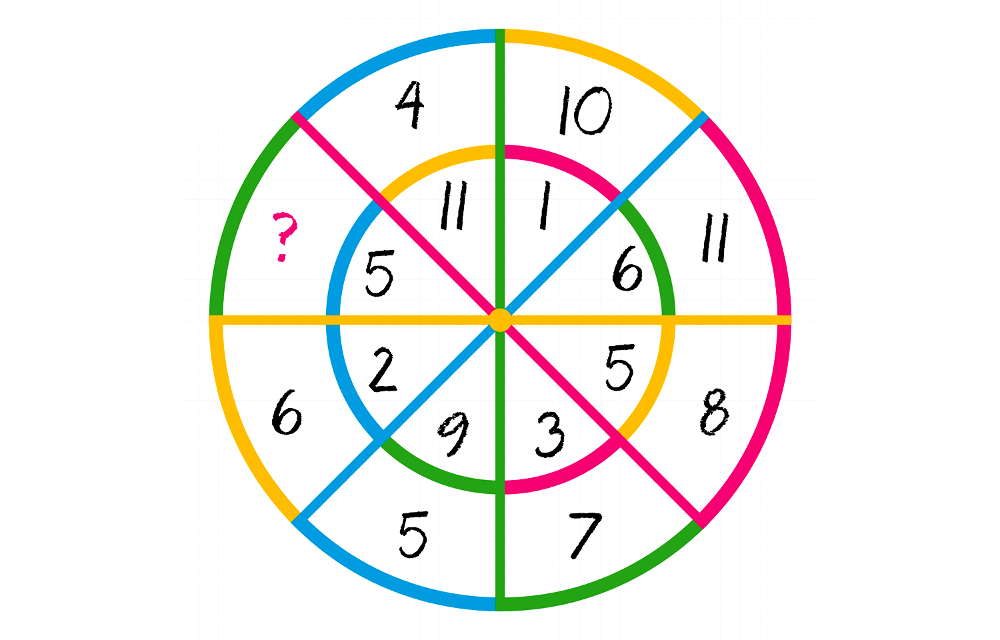

MATH PUZZLE: Can you replace...
[2491] MATH PUZZLE: Can you replace... - MATH PUZZLE: Can you replace the question mark with a number? - #brainteasers #math #riddles - Correct Answers: 343 - The first user who solved this task is Erkain Mahajanian
BRAIN TEASERS
enter your answer and press button OK

MATH PUZZLE: Can you replace...

MATH PUZZLE: Can you replace the question mark with a number?
Correct answers: 343
The first user who solved this task is Erkain Mahajanian.
#brainteasers #math #riddles
Register with your Google Account and start collecting points.
Check your ranking on list.

Two private detectives were do...

Two private detectives were doing some research on a scandalous divorce case in LA. At the husband's request they staked out the wife's bedroom, and sure enough, she had another man inside. The detectives remarked to one another that they were going at it as if sex was going out of style.
After watching rather furtively for quite a few minutes, one detective finally said, "As long as we’re here on the case, may be we should go in after him?"
To this the other replied, "Great idea! Who first?"
Jokes of the day - Daily updated jokes. New jokes every day.
Follow Brain Teasers on social networks

Brain Teasers

puzzles, riddles, mathematical problems, mastermind, cinemania...

Heinrich Anton de Bary

Died 19 Jan 1888 at age 56 (born 26 Jan 1831). German botanist known as a founder of modern mycology and plant pathology for his research into the roles of fungi and other agents in causing plant diseases. He determined the life cycles of many fungi, for which he developed a classification that has been retained in large part by modern mycologists. Among the first to study host-parasite interactions, and ways in which fungi penetrate host tissues, in 1853, he asserted that rust and smut were fungal diseases. In 1865 he proved that the life cycle of wheat rust involves two hosts, wheat and barberry. De Bary was the first to show (1866) that lichens consist of a fungus and an alga in intimate association. He coined the term symbiosis (1879) for the mutually beneficial partnership between two organisms.
This site uses cookies to store information on your computer. Some are essential to help the site properly. Others give us insight into how the site is used and help us to optimize the user experience. See our privacy policy.