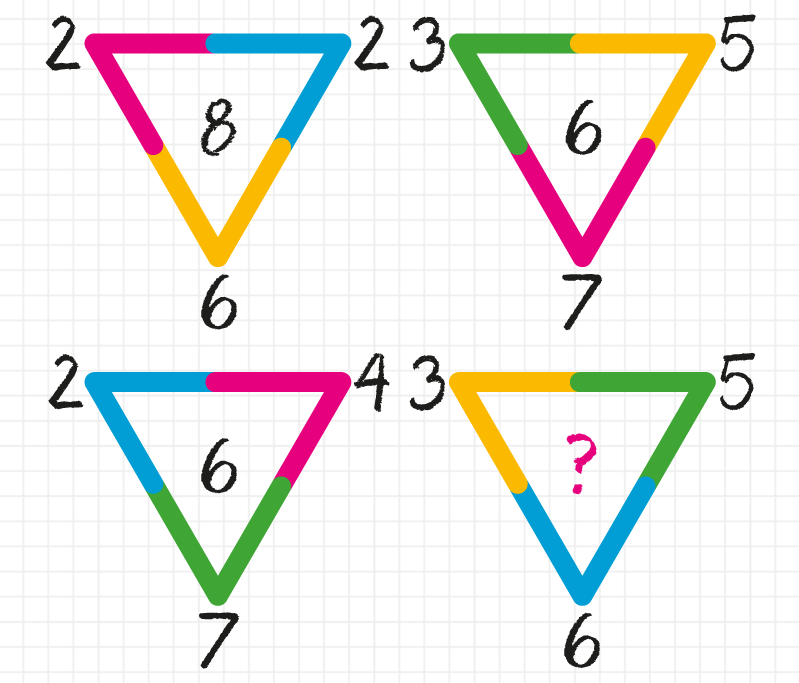
MATH PUZZLE: Can you replace...
[2693] MATH PUZZLE: Can you replace... - MATH PUZZLE: Can you replace the question mark with a number? - #brainteasers #math #riddles - Correct Answers: 441 - The first user who solved this task is Pratima Singh
BRAIN TEASERS
enter your answer and press button OK

MATH PUZZLE: Can you replace...

MATH PUZZLE: Can you replace the question mark with a number?
Correct answers: 441
The first user who solved this task is Pratima Singh.
#brainteasers #math #riddles

Register with your Google Account and start collecting points.
Check your ranking on list.

An Inscription Problem

According to the Knight-Ridder News Service, the inscription on the metal bands used by the U.S. Department of the Interior to tag migratory birds has been changed. The bands used to bear the address of the Washington Biological Survey, abbreviated, "Wash. Biol. Surv." until the agency received the following letter from an Arkansas camper:
"Dear Sirs: While camping last week I shot one of your birds. I think it was a crow. I followed the cooking instructions on the leg tag and I want to tell you it was horrible."
Jokes of the day - Daily updated jokes. New jokes every day.
Follow Brain Teasers on social networks

Brain Teasers

puzzles, riddles, mathematical problems, mastermind, cinemania...

Martin Rodbell

Died 7 Dec 1998 at age 73 (born 1 Dec 1925).American biochemist who was awarded the 1994 Nobel Prize for Physiology or Medicine for his discovery in the 1960s of natural signal transducers called G-proteins that help cells in the body communicate with each other. He shared the prize with Alfred G. Gilman, who later proved Rodbell's hypothesis, by isolating the G-protein, which is so named because it binds to nucleotides called guanosine diphosphate and guanosine triphosphate, or GDP and GTP. Prior to Rodbell's research, scientists believed that only two substances—a hormone receptor and an interior cell enzyme—were responsible for cellular communication. Rodbell, however, discovered that the G-protein acted as an intermediate signal transducer between the two.
This site uses cookies to store information on your computer. Some are essential to help the site properly. Others give us insight into how the site is used and help us to optimize the user experience. See our privacy policy.