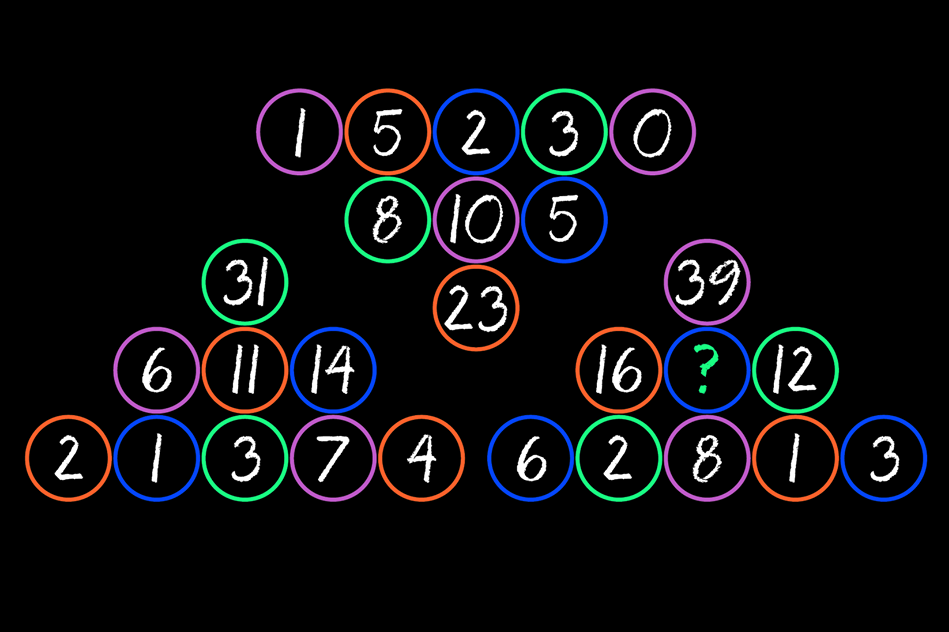
MATH PUZZLE: Can you replace...
[2937] MATH PUZZLE: Can you replace... - MATH PUZZLE: Can you replace the question mark with a number? - #brainteasers #math #riddles - Correct Answers: 122 - The first user who solved this task is Sanja Šabović
BRAIN TEASERS
enter your answer and press button OK

MATH PUZZLE: Can you replace...

MATH PUZZLE: Can you replace the question mark with a number?
Correct answers: 122
The first user who solved this task is Sanja Šabović.
#brainteasers #math #riddles
Register with your Google Account and start collecting points.
Check your ranking on list.

Painting lines

A guy is hired to paint lines on a little country road, so the boss gives him a big can of paint, a brush and sends him out... At the end of the day, when he comes to get paid, he tells the boss he got two miles done. The boss is pretty impressed. At the end of the second day, the painter reports that he did half a mile. The boss is a little surprised at the drop, but thinks maybe the first-day enthusiasm just wore off. At the end of the third day, the painter reports that he did 400 yards. The boss says, "That's quite a difference from the first day." The painter replies, "Yeah, well it's a lot longer walk back to the paint can now."
Jokes of the day - Daily updated jokes. New jokes every day.
Follow Brain Teasers on social networks

Brain Teasers

puzzles, riddles, mathematical problems, mastermind, cinemania...

Sir Henry Bessemer

Born 19 Jan 1813; died 15 Mar 1898 at age 85. English industrialist, metallurgist, inventor and engineer who developed the first process for manufacturing steel inexpensively (1856), leading to the development of the Bessemer converter. Bessemer invented his steel making process to solve a specific problem vexing another of his inventions, the self-spinning artillery shell. The converter removed impurities from molten pig iron by oxidation through air being blown through the molten iron. The oxidation also raised the temperature of the iron mass, keeping it molten. The oxidation process removed impurities such as silicon, manganese, and carbon as oxides, which oxides either escapd as gas or formed a solid slag. He also solved problems about the chemistry of ores, fuels, and steel. He held 110 patents at his death.
This site uses cookies to store information on your computer. Some are essential to help the site properly. Others give us insight into how the site is used and help us to optimize the user experience. See our privacy policy.