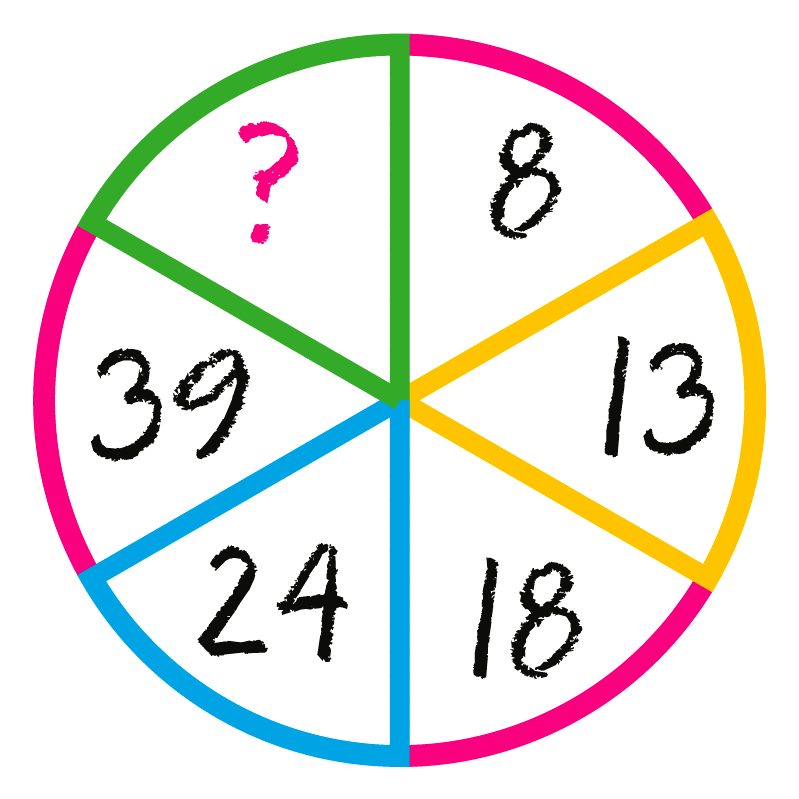
MATH PUZZLE: Can you replace...
[3229] MATH PUZZLE: Can you replace... - MATH PUZZLE: Can you replace the question mark with a number? - #brainteasers #math #riddles - Correct Answers: 908 - The first user who solved this task is On On Lunarbasil
BRAIN TEASERS
enter your answer and press button OK

MATH PUZZLE: Can you replace...

MATH PUZZLE: Can you replace the question mark with a number?
Correct answers: 908
The first user who solved this task is On On Lunarbasil.
#brainteasers #math #riddles
Register with your Google Account and start collecting points.
Check your ranking on list.

Happy Friday with fresh new jokes

I poured root beer in a square glass.
Now I just have beer.

Why can’t you explain puns to kleptomaniacs?
They always take things literally.

A traveling salesman offered me a deal on a coffin
I told him that's the last thing I need

Yesterday I saw a guy spill all his Scrabble letters on the road.
I asked him, “What’s the word on the street?"

I got my daughter a fridge for her birthday.
I can’t wait to see her face light up when she opens it.

Yesterday, I farted in the Apple Store and everyone got upset at me.
It’s not my fault they don’t have Windows…

San Francisco isn't just funny,
It's hill areas.

Jokes of the day - Daily updated jokes. New jokes every day.
Follow Brain Teasers on social networks

Brain Teasers

puzzles, riddles, mathematical problems, mastermind, cinemania...

Friedrich Hund

Died 31 Mar 1997 at age 101 (born 4 Feb 1896). Friedrich (Hermann) Hund was a German physicist known for his work on the electronic structure of atoms and molecules. He introduced a method of using molecular orbitals to determine the electronic structure of molecules and chemical bond formation. His empirical Hund's Rules (1925) for atomic spectra determine the lowest energy level for two electrons having the same n and l quantum numbers in a many-electron atom. (1) The lowest energy state has the maximum multiplicity consistent with the Pauli exclusion principle. (2) The lowest energy state has the maximum total electron orbital angular momentum quantum number, consistent with rule (1). They are explained by the quantum theory of atoms by calculations involving the repulsion between two electrons.
This site uses cookies to store information on your computer. Some are essential to help the site properly. Others give us insight into how the site is used and help us to optimize the user experience. See our privacy policy.