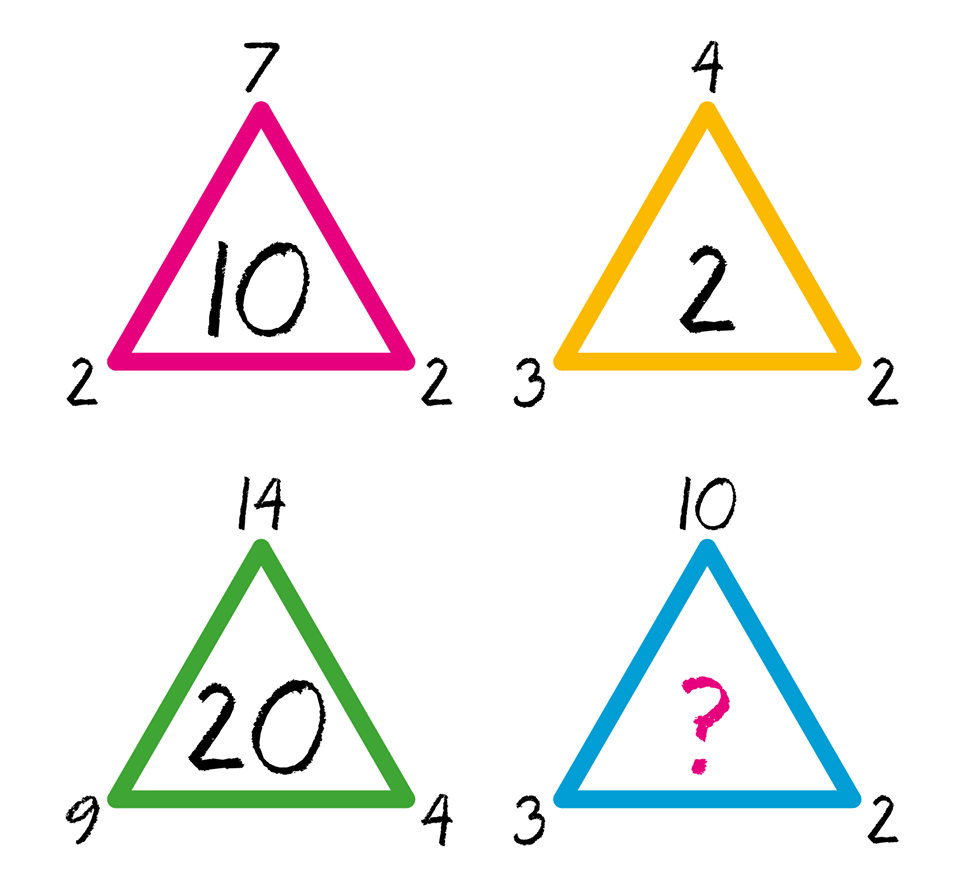
MATH PUZZLE: Can you replace...
[3546] MATH PUZZLE: Can you replace... - MATH PUZZLE: Can you replace the question mark with a number? - #brainteasers #math #riddles - Correct Answers: 351 - The first user who solved this task is Linda Tate Young
BRAIN TEASERS
enter your answer and press button OK

MATH PUZZLE: Can you replace...

MATH PUZZLE: Can you replace the question mark with a number?
Correct answers: 351
The first user who solved this task is Linda Tate Young.
#brainteasers #math #riddles
Register with your Google Account and start collecting points.
Check your ranking on list.

In the zoo

A certain zoo had acquired a very rare species of gorilla. Within a few weeks, the female gorilla became very horny and difficult to handle and, upon examination, the zoo veterinarian found that the gorilla was in heat. To make matters worse, there was no male gorilla of the species available.

While reflecting on their problem the zoo administrators noticed Mike, an employee responsible for cleaning the animals' cages. Mike it was rumored, possessed ample ability to satisfy a female, but he wasn't very bright. So the zoo administrators thought they might have a solution and Mike was approached with a proposition: would he be willing to have sex with the gorilla for $500?

Mike showed some interest but said he would have to think the matter over carefully. The following day Mike announced that he would accept their offer, but only under three conditions.

'First,' he said, 'I don't want to have to kiss her.

Secondly I want nothing to do with any offspring that may result from the union.'

The zoo administration quickly agreed to these conditions, so they asked what his third condition was.

'Well,' said Mike, 'you've gotta give me another week to come up with the $500.'

Jokes of the day - Daily updated jokes. New jokes every day.
Follow Brain Teasers on social networks

Brain Teasers

puzzles, riddles, mathematical problems, mastermind, cinemania...

Comte Claude Louis Berthollet

Born 9 Dec 1748; died 6 Nov 1822 at age 73.French chemist who was the first to note that the completeness of chemical reactions depends in part upon the masses of the reacting substances (1803); he thus came close to formulating the law of mass action. Though he incorrectly concluded that elements unite in all proportions, his resulting controversy with the chemist Joseph-Louis Proust led to the establishment of the law of definite proportions. He continued Carl Scheele's research on chlorine, showing in 1785 how it could be used for bleaching. He continued Joseph Priestley's investigation of ammonia, and was the first to show it was a compound of hydrogen and nitrogen. He discovered potassium chlorate.
This site uses cookies to store information on your computer. Some are essential to help the site properly. Others give us insight into how the site is used and help us to optimize the user experience. See our privacy policy.