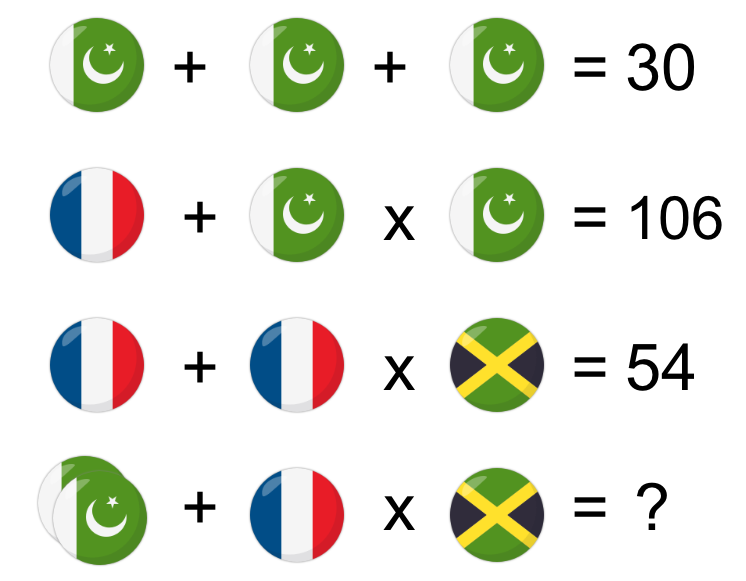
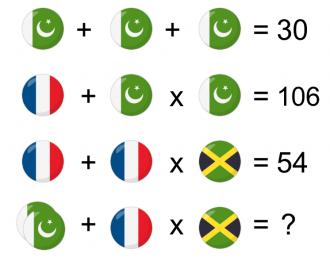
MATH PUZZLE: Can you replace...
[6402] MATH PUZZLE: Can you replace... - MATH PUZZLE: Can you replace the question mark with a number? - #brainteasers #math #riddles - Correct Answers: 62 - The first user who solved this task is Nasrin 24 T
BRAIN TEASERS
enter your answer and press button OK

MATH PUZZLE: Can you replace...

MATH PUZZLE: Can you replace the question mark with a number?
Correct answers: 62
The first user who solved this task is Nasrin 24 T.
#brainteasers #math #riddles
Register with your Google Account and start collecting points.
Check your ranking on list.

35 safe short jokes and puns

1. Why couldn’t the bicycle stand up by itself?
Because it was two-tired!

2. What do you call a dinosaur with an extensive vocabulary?
A thesaurus!

3. Why did the golfer bring two pairs of pants?
In case he got a hole-in-one!

4. Why did the picture go to jail?
Because it was framed!

5. What do you call a group of musical whales?
An orca-stra!

6. What do you call a bear with no teeth?
A gummy bear!

7. Why did the math book look sad?
Because it had too many problems!

8. What do you call a can opener that doesn’t work?
A can’t opener!

9. How do you catch a squirrel?
Climb a tree and act like a nut!

10. What is the skeleton’s favorite musical instrument?
A trombone!

11. Why couldn’t the pony sing a lullaby?
She was a little horse!

12. Why was the belt arrested?
For holding up a pair of pants!

13. How do you organize a space party?
You planet!

14. Why did the cookie go to the doctor?
Because it felt crummy!

15. What do you call a boomerang that won’t come back?
A stick!

16. What did the buffalo say to his son when he left for college?
Bison!

17. Why did the chicken go to the seance?
To get to the other side!

18. What do you call a snobbish criminal going downstairs?
A condescending con descending!

19. How does a train eat?
It goes chew-chew!

20. Why don’t oysters donate to charity?
Because they’re shellfish!

21. What do you call a cow with no legs?
Ground beef!

22. What did the zero say to the eight?
Nice belt!

23. Why did the scarecrow become a motivational speaker?
Because he always found a way to lift people’s crops!

24. What do you call a nosy pepper?
Jalapeño business!

25. How do you make a tissue dance?
Put a little boogie in it!

26. Why did the crab never share?
Because he was shellfish!

27. What do you get when you cross a computer and a lifeguard?
A screensaver!

28. Why did the banana go to the doctor?
It wasn’t peeling well!

29. What do you call a cow that can play an instrument?
A moosician!

30. What’s a pirate’s favorite letter?
Arrrrrrrr!

31. Why did the chicken cross the playground?
To get to the other slide!

32. What do you call a dog that can do magic?
A Labracadabrador!

33. What did the big flower say to the little flower?
Hi, bud!

34. What do you call a sleepwalking nun?
A roamin’ Catholic!

35. What did the traffic light say to the car?
Don’t look, I’m changing!!

Jokes of the day - Daily updated jokes. New jokes every day.
Follow Brain Teasers on social networks

Brain Teasers

puzzles, riddles, mathematical problems, mastermind, cinemania...

Edward Lawrie Tatum

Born 14 Dec 1909; died 5 Nov 1975 at age 65.American biochemist whose research helped create the field of molecular genetics. He helped demonstrate that genes determine the structure of particular enzymes or otherwise act by regulating specific chemical processes in living things. With George Beadle and Joshua Lederberg, he won the 1958 Nobel Prize for Physiology or Medicine. During WW II, his work was of use in maximizing penicillin production, and it has also made possible the introduction of new methods for assaying vitamins and amino acids in foods and tissues. In 1940, in collaboration with George Beadle, he had made his studies on the pink bread mold, Neurospora crassa. They irradiated spores of bread moulds, allowed them to germinate, and discovered three mutant strains that had lost the ability to synthesize specific vitamins, implying that in each case the necessary enzyme was missing or nonfunctional. The mutants differed from normal by only a single gene, which showed that specific genes determine the structure of particular enzymes or otherwise act by regulating specific chemical processes in living things. In 1945, he moved to Yale and he extended his techniques to yeast and bacteria. Tatum and Lederberg discovered genetic recombination in certain bacteria (1946).
This site uses cookies to store information on your computer. Some are essential to help the site properly. Others give us insight into how the site is used and help us to optimize the user experience. See our privacy policy.