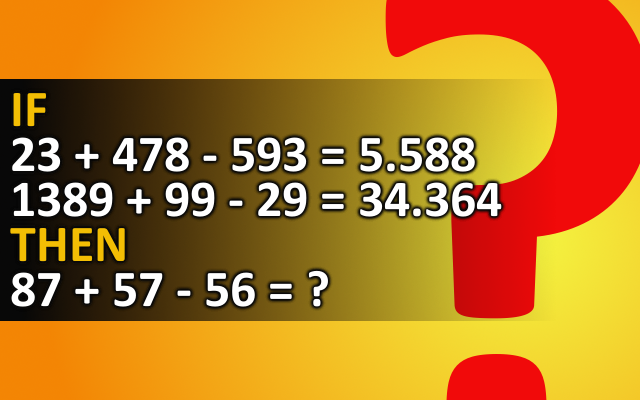
Mathematical Puzzle: IF 23+4...
[2585] Mathematical Puzzle: IF 23+4... - Mathematical Puzzle: IF 23+478-593=5.588 and 1389+99-29=34.364 THEN 87+57-56=? - #brainteasers #math #riddles - Correct Answers: 16 - The first user who solved this task is Erkain Mahajanian
BRAIN TEASERS
enter your answer and press button OK

Mathematical Puzzle: IF 23+4...

Mathematical Puzzle: IF 23+478-593=5.588 and 1389+99-29=34.364 THEN 87+57-56=?
Correct answers: 16
The first user who solved this task is Erkain Mahajanian.
#brainteasers #math #riddles
Register with your Google Account and start collecting points.
Check your ranking on list.

What does two plus two equal?

A mathematician, a statistician and an accountant apply for the same job. The interviewer calls in the mathematician and asks "What does two plus two equal?"

The mathematician replies "Four." The interviewer asks "Four, exactly?" The mathematician looks at the interviewer incredulously and says "Yes, four, exactly."

Then the interviewer calls in the statistician and asks the same question "What does two plus two equal?" The statistician says "On average, four - give or take ten percent, but on average, four."

Then the interviewer calls in the accountant and poses the same question "What does two plus two equal?"

The accountant gets up, locks the door, closes the shade, sits down next to the interviewer and says "What do you want it to equal?"

Jokes of the day - Daily updated jokes. New jokes every day.
Follow Brain Teasers on social networks

Brain Teasers

puzzles, riddles, mathematical problems, mastermind, cinemania...

Edward Charles Pickering

Died 3 Feb 1919 at age 72 (born 19 Jul 1846). Edward Charles Pickering, was born Boston, Mass., U.S. physicist and astronomer. After graduating from Harvard, he taught physics for ten years at MIT where he built the first instructional physics laboratory in the United States. At age 30, he directed the Harvard College Observatory for 42 years. His observations were assisted by a staff of women, including Annie Jump Cannon. He introduced the use of the meridian photometer to measure the magnitude of stars, and established the Harvard Photometry (1884), the first great photometric catalog. By establishing a station in Peru (1891) to make the southern photographs, he published the first all-sky photographic map (1903).
This site uses cookies to store information on your computer. Some are essential to help the site properly. Others give us insight into how the site is used and help us to optimize the user experience. See our privacy policy.