PALINDROME (1446908864)
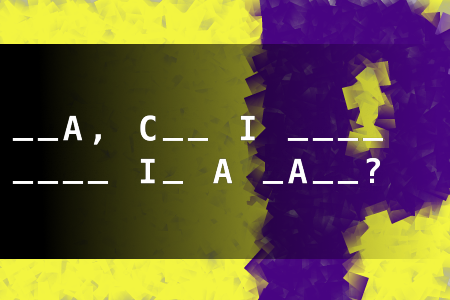
[1646] PALINDROME (1446908864) - Make the palindrome of the following letters: A, A, A, A, A, A, B, B, C, C, E, E, I, I, N, N, S, S, T, T, V, V - #brainteasers #wordpuzzles #palindrome - Correct Answers: 31 - The first user who solved this task is Sanja Šabović
BRAIN TEASERS
enter your answer and press button OK

PALINDROME (1446908864)

Make the palindrome of the following letters: A, A, A, A, A, A, B, B, C, C, E, E, I, I, N, N, S, S, T, T, V, V
Correct answers: 31
The first user who solved this task is Sanja Šabović.
#brainteasers #wordpuzzles #palindrome
Register with your Google Account and start collecting points.
Check your ranking on list.

Ex-Girlfriend

A man and his wife are dining at a table in a plush restaurant, and the husband keeps staring at a drunken lady swigging her drink as she sits alone at a nearby table.
The wife asks, "Do you know her?"
"Yes," sighs the husband, "she's my ex-girlfriend. I understand she took to drinking right after we split up seven years ago, and I hear she hasn't been sober since."
"My God!" says the wife. "Who would think a person could go on celebrating that long?"   

Jokes of the day - Daily updated jokes. New jokes every day.
Follow Brain Teasers on social networks

Brain Teasers

puzzles, riddles, mathematical problems, mastermind, cinemania...

Deuterium

In 1933, Ernest Rutherford suggested the names diplogen for the newly discovered heavy hydrogen isotope and diplon for its nucleus. He presented these ideas in the Discussion on Heavy Hydrogen at the Royal Society. For ordinary hydrogen, the lightest of the atoms, having a nuclues of a sole proton, he coined a related name: haplogen. (Greek: haploos, single; diploos, double.) In 1931, Harold Urey had discovered small quantities of atoms of heavy hydrogen wherever ordinary hydrogen occurred. The mass of its nucleus was double that of ordinary hydrogen. This hydrogen-2 is now called deuterium, as named by Urey (Greek: deuteros, second). Its nucleus, named a deuteron, has a neutron in addition to a proton.[ref: Proc. Roy. Soc. A, vol. 144 (1934)]
This site uses cookies to store information on your computer. Some are essential to help the site properly. Others give us insight into how the site is used and help us to optimize the user experience. See our privacy policy.