Remove 5 letters from this s...
[2269] Remove 5 letters from this s... - Remove 5 letters from this sequence (OPLPJORUTUSNITKY) to reveal a familiar English word. - #brainteasers #wordpuzzles - Correct Answers: 95 - The first user who solved this task is Erkain Mahajanian
BRAIN TEASERS
enter your answer and press button OK

Remove 5 letters from this s...

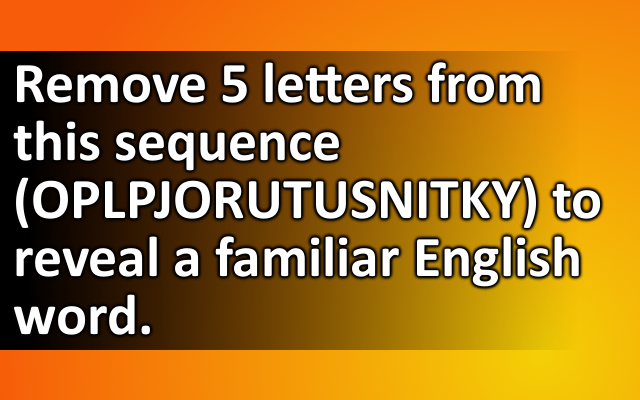
Remove 5 letters from this sequence (OPLPJORUTUSNITKY) to reveal a familiar English word.
Correct answers: 95
The first user who solved this task is Erkain Mahajanian.
#brainteasers #wordpuzzles
Register with your Google Account and start collecting points.
Check your ranking on list.

Used Car

It was a small town and the patrolman was making his evening rounds As he was checking a used car lot, he came upon two little old ladies sitting in a used car. He stopped and asked them if they were stealing the car. They said "Heavens no, we bought it."
He said, "Then why don't you drive it away".
Each of the women said "We can't drive".
The officer momentarily shook his head and then asked "Then why did you buy it?"
They answered, "We were told if we bought a car here, we'd get screwed, so we are just waiting.

Jokes of the day - Daily updated jokes. New jokes every day.
Follow Brain Teasers on social networks

Brain Teasers

puzzles, riddles, mathematical problems, mastermind, cinemania...

Irving Langmuir

Born 31 Jan 1881; died 16 Aug 1957 at age 76. American physical chemist whose studies of molecular films on solid and liquid surfaces opened new fields in colloid research and biochemistry and won him the Nobel Prize for Chemistry in 1932. His early work on gases led to the invention of the Langmuir condensation pump. In 1913, Langmuir found that the life of the tungsten vacuum bulbs then in use could be extended considerably if they were filled with a mixture of nitrogen and argon. He also developed an atomic-hydrogen welding torch capable of temperatures up to 3,000°C, and made first use of the term plasma. While studying atomic structure he introduced the terms covalence and electrovalence. In surface chemistry, he worked the phenomenon of adsorption and the application of this to catalysis.
This site uses cookies to store information on your computer. Some are essential to help the site properly. Others give us insight into how the site is used and help us to optimize the user experience. See our privacy policy.