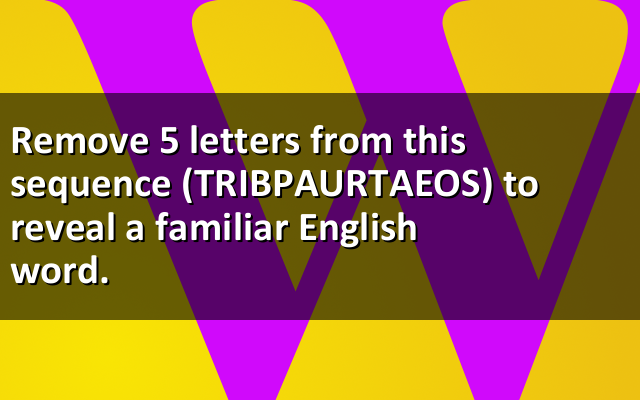
Remove 5 letters from this seq...
Remove 5 letters from this sequence (TRIBPAURTAEOS) to reveal a familiar English word.
45 clean romantic Knock knock jokes
1. Knock knock.
Who's there?
Olive.
Olive who?
Olive you, and I can't wait to get to know you better!
2. Knock knock.
Who's there?
Lettuce.
Lettuce who?
Lettuce go on a date and make some memories together!
3. Knock knock.
Who's there?
Honeydew.
Honeydew who?
Honeydew you want to go out with me?
4. Knock knock.
Who's there?
Amour.
Amour who?
Amour than happy to have met you!
5. Knock knock.
Who's there?
Kiss.
Kiss who?
Kiss me if I'm wrong, but dinosaurs still exist, right?
6. Knock knock.
Who's there?
Sugar.
Sugar who?
Sugar, I'm falling for you!
7. Knock knock.
Who's there?
Charming.
Charming who?
Charming to meet you. Can I take you out for dinner?
8. Knock knock.
Who's there?
Berry.
Berry who?
Berry nice to meet you. Can I have your number?
9. Knock knock.
Who's there?
Cupid.
Cupid who?
Cupid called. He wants his arrow back because I've fallen for you!
10. Knock knock.
Who's there?
Fella.
Fella who?
Fella madly in love with you!
11. Knock knock.
Who's there?
Wanda.
Wanda who?
Wanda hang out with me this weekend?
12. Knock knock.
Who's there?
Romeo.
Romeo who?
Romeo, Romeo, wherefore art thou Romeo? Just kidding, let's go out!
13. Knock knock.
Who's there?
Apple.
Apple who?
Apple-ogize for taking up your time, but can I take you out?
14. Knock knock.
Who's there?
Cuddle.
Cuddle who?
Cuddle me close, and let's have a fantastic time!
15. Knock knock.
Who's there?
Prince.
Prince who?
Prince Charming has finally arrived, and he's asking you out!
16. Knock knock.
Who's there?
Boo.
Boo, who?
Don't cry, babe, it's just me!
17. Knock knock.
Who's there?
Olive.
Olive who?
Olive you, and I can't wait to hold you tight!
18. Knock knock.
Who's there?
Lettuce.
Lettuce who?
Lettuce snuggle up and watch our favorite movie together!
19. Knock knock.
Who's there?
Honeydew.
Honeydew who?
Honeydew you know how much I love you?
20. Knock knock.
Who's there?
Sweetie.
Sweetie who?
Sweetie, you make my heart skip a beat!
21. Knock knock.
Who's there?
Sugar.
Sugar who?
Sugar, you're the sweetest thing in my life!
22. Knock knock.
Who's there?
Darling.
Darling who?
Darling, you light up my world!
23. Knock knock.
Who's there?
Berry.
Berry who?
Berry in love with you, my darling!
24. Knock knock.
Who's there?
Cupid.
Cupid who?
Cupid struck me with love the moment I met you!
25. Knock knock.
Who's there?
Baby.
Baby who?
Baby, you complete me!
26. Knock knock.
Who's there?
Angel.
Angel who?
Angel, you're the one I've been waiting for!
27. Knock knock.
Who's there?
Juliet.
Juliet who?
Juliet, I can't stop thinking about you!
28. Knock knock.
Who's there?
Apple.
Apple who?
Apple of my eye, you're the one for me!
29. Knock knock.
Who's there?
Cuddle.
Cuddle who?
Cuddle me close, my love!
30. Knock knock.
Who's there?
Princess.
Princess who?
Princess, you're the queen of my heart!
31. Knock knock.
Who's there?
Lettuce.
Lettuce who?
Lettuce cuddle up and create a cozy paradise of love!
32. Knock knock.
Who's there?
Olive.
Olive who?
Olive you, and I can't wait to explore a world of adventures with you!
33. Knock knock.
Who's there?
Sugar.
Sugar who?
Sugar, you're my sweet addiction, and I can't get enough of you!
34. Knock knock.
Who's there?
Baby.
Baby who?
Baby, you light up my world like nobody else!
35. Knock knock.
Who's there?
Berry.
Berry who?
Berry lucky to have you by my side, my love!
36. Knock knock.
Who's there?
Cupid.
Cupid who?
Cupid shot an arrow, and it struck my heart when I met you!
37. Knock knock.
Who's there?
Mystery.
Mystery who?
Mystery deepens when I think of you, and I'm excited to uncover it together!
38. Knock knock.
Who's there?
Prince.
Prince who?
Prince Charming might be a fairy tale, but you're my real-life prince!
39. Knock knock.
Who's there?
Flirt.
Flirt who?
Flirt with me forever, and let's keep the spark alive!
40. Knock knock.
Who's there?
Angel.
Angel who?
Angel, you bring heaven into my life, and I'm grateful for every moment with you!
41. Knock knock.
Who's there?
Daisy.
Daisy who?
Daisy, you make me smile every day, and I'm so lucky to have you!
42. Knock knock.
Who's there?
Romeo.
Romeo who?
Romeo couldn't resist knocking on your heart, and I'm here to stay!
43. Knock knock.
Who's there?
Echo.
Echo who?
Echo, you've captured my heart, and your love echoes through my soul!
44. Knock knock.
Who's there?
Sunshine.
Sunshine who?
Sunshine, you brighten up my world, and I'm forever grateful for you!
45. Knock knock.
Who's there?
Dream.
Dream who?
Dream, you're the one I've been waiting for, and being with you is a dream come true!