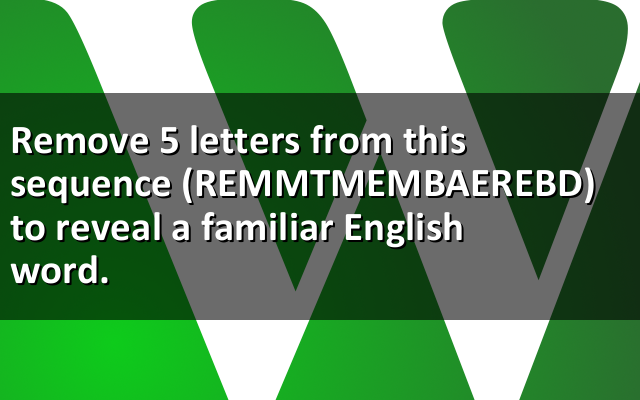
Remove 5 letters from this seq...
[5279] Remove 5 letters from this seq... - Remove 5 letters from this sequence (REMMTMEMBAEREBD) to reveal a familiar English word. - #brainteasers #wordpuzzles - Correct Answers: 40 - The first user who solved this task is Djordje Timotijevic
BRAIN TEASERS
enter your answer and press button OK

Remove 5 letters from this seq...

Remove 5 letters from this sequence (REMMTMEMBAEREBD) to reveal a familiar English word.
Correct answers: 40
The first user who solved this task is Djordje Timotijevic.
#brainteasers #wordpuzzles
Register with your Google Account and start collecting points.
Check your ranking on list.

Yesterday I went to the doctor...

Yesterday I went to the doctor for my yearly physical. My blood pressure was high, my cholesterol was high, I'd gained some weight,and I didn't feel so hot.
My doctor said eating right doesn't have to be complicated and it would solve my physical problems. He said just think in colors; Fill your plate with bright colors; greens, yellows, reds, etc.
I went right home and ate an entire bowl of M&M's and sure enough, I felt better immediately. I never knew eating right could be so easy.
Jokes of the day - Daily updated jokes. New jokes every day.
Follow Brain Teasers on social networks

Brain Teasers

puzzles, riddles, mathematical problems, mastermind, cinemania...

Fritz Wolfgang London

Born 7 Mar 1900; died 30 Mar 1954 at age 54.German-American physicist who, with Walter Heitler, devised the first quantum mechanical treatment of the hydrogen molecule, while working with Erwin Schrödinger at the University of Zurich. In a seminal paper (1927), they developed a wave equation for the hydrogen molecule with which it was possible to calculate approximate values of the molecule's ionization potential, heat of dissociation, and other constants. These predicted values were reasonably consistent with empirical values obtained by spectroscopic and chemical means. This theory of the chemical binding of homopolar molecules is considered one of the most important advances in modern chemistry. The approach is later called the valence-bond theory.
This site uses cookies to store information on your computer. Some are essential to help the site properly. Others give us insight into how the site is used and help us to optimize the user experience. See our privacy policy.