
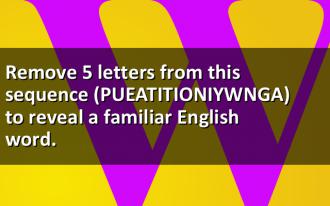
Remove 5 letters from this seq...
Remove 5 letters from this sequence (PUEATITIONIYWNGA) to reveal a familiar English word.Correct answers: 42
The first user who solved this task is Djordje Timotijevic.
#brainteasers #wordpuzzles

Two guys, one 80 and one 87...
Two guys, one 80 and one 87, were sitting on their usual park bench one morning.
The 87 year old had just finished his morning jog and wasn't even short of breath.
The 80 year old was amazed at his friend's stamina and asked him what he did to have so much energy.
The 87 year old said, "Well, I eat Italian bread every day. It keeps your energy level high and you'll have great stamina with the ladies."
So, on the way home, 80 year old stops at the bakery. As he was looking around, the lady asked if he needed any help. He said "Do you have any Italian bread?"
She said, "Yes, there's a whole shelf of it. Would you like some?"
He said, "I want 5 loaves."
She said, "My goodness, 5 loaves ... by the time you get to the 5th loaf, it'll be hard."
He replied, "I can't believe it, everybody knows about this sh*t but me."
The 87 year old had just finished his morning jog and wasn't even short of breath.
The 80 year old was amazed at his friend's stamina and asked him what he did to have so much energy.
The 87 year old said, "Well, I eat Italian bread every day. It keeps your energy level high and you'll have great stamina with the ladies."
So, on the way home, 80 year old stops at the bakery. As he was looking around, the lady asked if he needed any help. He said "Do you have any Italian bread?"
She said, "Yes, there's a whole shelf of it. Would you like some?"
He said, "I want 5 loaves."
She said, "My goodness, 5 loaves ... by the time you get to the 5th loaf, it'll be hard."
He replied, "I can't believe it, everybody knows about this sh*t but me."