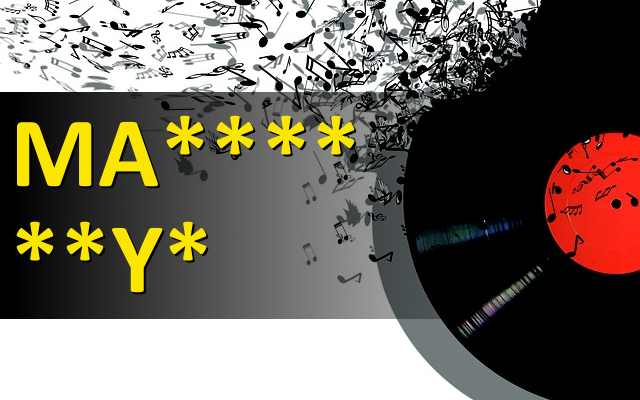
Replace asterisk symbols with ...
[4313] Replace asterisk symbols with ... - Replace asterisk symbols with a letters (MA**** **Y*) and guess the name of musician. Length of words in solution: 6,4. - #brainteasers #music - Correct Answers: 22 - The first user who solved this task is Manguexa Wagle
BRAIN TEASERS
enter your answer and press button OK

Replace asterisk symbols with ...

Replace asterisk symbols with a letters (MA**** **Y*) and guess the name of musician. Length of words in solution: 6,4.
Correct answers: 22
The first user who solved this task is Manguexa Wagle.
#brainteasers #music
Register with your Google Account and start collecting points.
Check your ranking on list.

A pastor's wife was expecting...

A pastor's wife was expecting a baby, so he stood before the congregation and asked for a raise. After much discussion, they passed a rule that whenever the pastor's family expanded, so would his paycheck.
After 6 children, this started to get expensive and the congregation decided to hold another meeting to discuss the pastor's expanding salary.
A great deal of yelling and inner bickering ensued, as to how much the pastor's additional children were costing the church, and how much more it could potentially cost.
After listening to them for about an hour, the pastor rose from his chair and spoke, "Children are a gift from God, and we will take as many gifts as He gives us."
Silence fell over the congregation. In the back pew, a little old lady struggled to stand, and finally said in her frail voice,
"Rain is also a gift from God, but when we get too much of it, we wear rubbers."
The entire said, "Amen."
Jokes of the day - Daily updated jokes. New jokes every day.
Follow Brain Teasers on social networks

Brain Teasers

puzzles, riddles, mathematical problems, mastermind, cinemania...

Rudolf Carnap

Died 14 Sep 1970 at age 79 (born 18 May 1891). German-American philosopher who made significant contributions to logic and the philosophy of science. To avoid the ambiguities resulting from the use of ordinary language, he made a logical analysis of language. He believed in studying philosphical issues in artificial languages constructed under the rules of logic and mathematics. His applications of such languages included the different interpretation of probability, the nature of explanation and the distinctions between analytic and synthetic, a priori and a posteriori, and necessary and contingent statements. His influential books include The Logical Structure of the World (1928) and The Logical Syntax of Language (1934).«
This site uses cookies to store information on your computer. Some are essential to help the site properly. Others give us insight into how the site is used and help us to optimize the user experience. See our privacy policy.