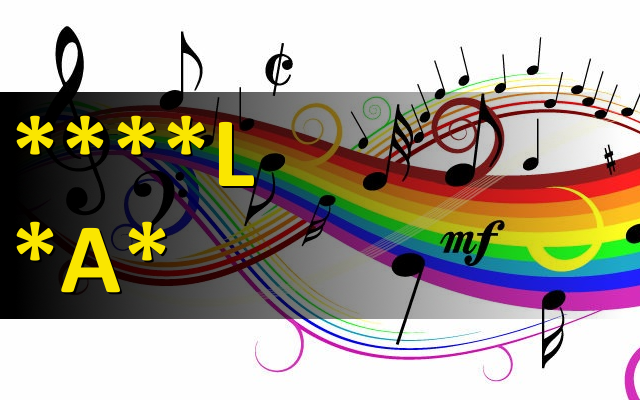

Replace asterisk symbols with ...
[5215] Replace asterisk symbols with ... - Replace asterisk symbols with a letters (****L *A*) and guess the name of musician band. Length of words in solution: 5,3. - #brainteasers #music - Correct Answers: 13 - The first user who solved this task is Djordje Timotijevic
BRAIN TEASERS
enter your answer and press button OK

Replace asterisk symbols with ...

Replace asterisk symbols with a letters (****L *A*) and guess the name of musician band. Length of words in solution: 5,3.
Correct answers: 13
The first user who solved this task is Djordje Timotijevic.
#brainteasers #music
Register with your Google Account and start collecting points.
Check your ranking on list.

Three old men were sitting aro...

Three old men were sitting around talking about who had the worst health problems. The seventy-year-old said, "Have I got a problem. Every morning I get up at 7:30 and have to take a piss, but I have to stand at the toilet for an hour 'cause my pee barely trickles out."
"Heck, that's nothing, " said the eighty year old. "Every morning at 8:30 I have to take a shit, but I have to sit on the can for hours because of my constipation. It's terrible".
The ninety-year-old said, "You guys think you have problems! Every morning at 7:30 I piss like a racehorse, and at 8:30 I shit like a pig. The trouble with me is, I don't wake up till eleven."
Jokes of the day - Daily updated jokes. New jokes every day.
Follow Brain Teasers on social networks

Brain Teasers

puzzles, riddles, mathematical problems, mastermind, cinemania...

Hideki Yukawa

Died 8 Sep 1981 at age 74 (born 23 Jan 1907). Japanese physician and physicist who shared the 1949 Nobel Prize for Physics for “his prediction of the existence of mesons on the basis of theoretical work on nuclear forces.” In his 1935 paper, On the Interaction of Elementary Particles*, he proposed a new field theory of nuclear forces that predicted the existence of the previously unknown meson. Mesons are particles heavier than electrons but lighter than protons. One type of meson was subsequently discovered in cosmic rays in 1937 by American physicists, encouraging him to further develop meson theory. From 1947, he worked mainly on the general theory of elementary particles in connection with the concept of the “non-local” field. He was the first Japanese Nobel Prize winner.«*Proc.Phys.-Math. Soc.Japan, 17, p. 48.
This site uses cookies to store information on your computer. Some are essential to help the site properly. Others give us insight into how the site is used and help us to optimize the user experience. See our privacy policy.