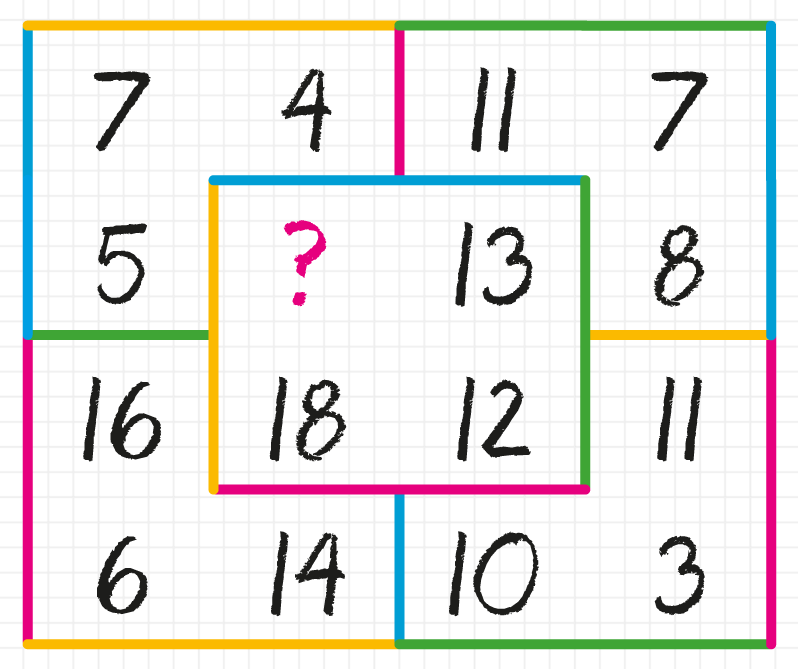
Replace the question mark with a number
[3093] Replace the question mark with a number - MATH PUZZLE: Can you replace the question mark with a number? - #brainteasers #math #riddles - Correct Answers: 795 - The first user who solved this task is Дејан Шкребић
BRAIN TEASERS
enter your answer and press button OK

Replace the question mark with a number

MATH PUZZLE: Can you replace the question mark with a number?
Correct answers: 795
The first user who solved this task is Дејан Шкребић.
#brainteasers #math #riddles
Register with your Google Account and start collecting points.
Check your ranking on list.

It doesn't hurt to take a har...

It doesn't hurt to take a hard look at yourself from time to time, and this should help get you started.
During a visit to the mental asylum, a visitor asked the director what the criterion was that defined whether or not a patient should be institutionalized.
"Well," said the Director, "we fill up a bathtub, then we offer a teaspoon, a teacup and a bucket to the patient and ask him or her to empty the bathtub."
"Oh, I understand," said the visitor. "A normal person would use the bucket because it's bigger than the spoon or the teacup."
"No," said the Director, "A normal person would pull the plug. Do you want a room with or without a view?"
Jokes of the day - Daily updated jokes. New jokes every day.
Follow Brain Teasers on social networks

Brain Teasers

puzzles, riddles, mathematical problems, mastermind, cinemania...

Sir Hans Adolf Krebs

Born 25 Aug 1900; died 22 Nov 1981 at age 81. German-British biochemist who shared (with Fritz Lipmann) the 1953 Nobel Prize for Physiology or Medicine for the discovery in living organisms of the series of chemical reactions known as the tricarboxylic acid cycle (also called the citric acid cycle, or Krebs cycle)—the basic system for the essential pathway of oxidation process within the cell. These reactions involve the conversion—in the presence of oxygen—of substances that are formed by the breakdown of sugars, fats, and protein components to carbon dioxide, water, and energy-rich compounds. The Krebs cycle explains two simultaneous processes: the degradation reactions which yield energy, and the building-up processes which use up energy.
This site uses cookies to store information on your computer. Some are essential to help the site properly. Others give us insight into how the site is used and help us to optimize the user experience. See our privacy policy.