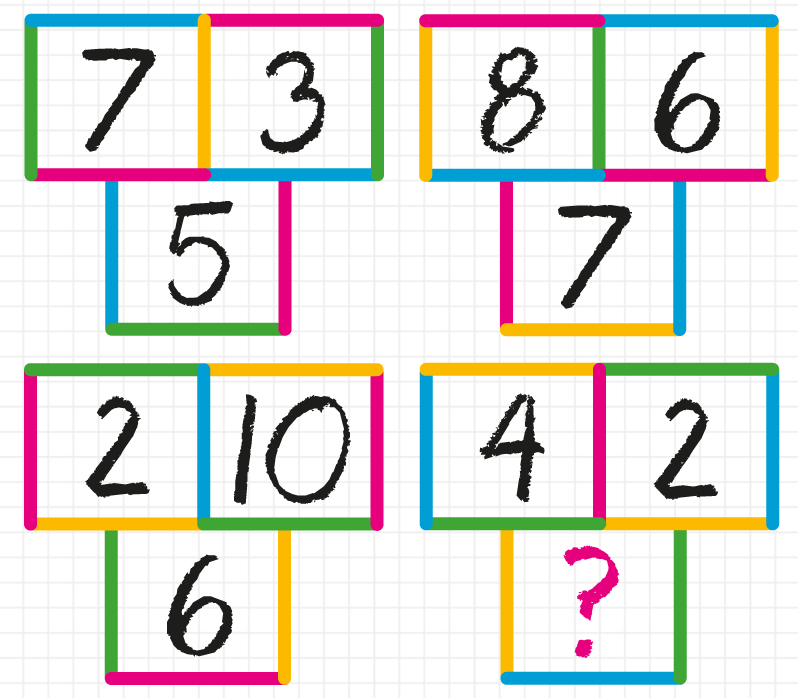
Replace the question mark with a number
[3414] Replace the question mark with a number - MATH PUZZLE: Can you replace the question mark with a number? - #brainteasers #math #riddles - Correct Answers: 337 - The first user who solved this task is Sanja Šabović
BRAIN TEASERS
enter your answer and press button OK

Replace the question mark with a number

MATH PUZZLE: Can you replace the question mark with a number?
Correct answers: 337
The first user who solved this task is Sanja Šabović.
#brainteasers #math #riddles
Register with your Google Account and start collecting points.
Check your ranking on list.

Praying and Sleeping

Two men arrive at the Pearly Gates at about the same time, both wanting to know if they will be admitted to heaven. St. Peter asks the first man his name, where he is from, and what he did in life.
The man answers that he is John Smith and that he was a taxi driver in New York City.
St. Peter looks through his book, then gives the man a luxurious silken robe and a golden staff, and bids him welcome into heaven for his eternal reward.
St. Peter then asks the second man the same questions. He replies that his name is Thomas O'Malley, and that he was a Catholic priest in Chicago. St. Peter looks in his book, then gives him a cotton robe and a wooden staff, and bids him to enter into heaven for his eternal reward.
Father O'Malley says, Wait a minute! Why did that taxi driver get a silken robe and golden staff while I, a Catholic Priest and a man of God, got a cotton robe and wooden staff?
St. Peter told him that the rewards in heaven are based on results, and while Father O'Malley preached, people slept, but while John Smith drove, people prayed!

Jokes of the day - Daily updated jokes. New jokes every day.
Follow Brain Teasers on social networks

Brain Teasers

puzzles, riddles, mathematical problems, mastermind, cinemania...

Sir J.J. Thomson

Died 30 Aug 1940 at age 83 (born 18 Dec 1856). Joseph John Thomson was an English physicist who helped revolutionize the knowledge of atomic structure by his discovery of the electron (1897). He received the Nobel Prize for Physics in 1906 and was knighted in 1908. Thomson experimented with currents of electricity inside empty glass tubes, investigating a long-standing puzzle known as “cathode rays.” His experiments prompted him to make a bold proposal: these mysterious rays are streams of particles much smaller than atoms. He called these particles “corpuscles,” and suggested that they might make up all of the matter in atoms. It was startling to imagine particles inside the atom at a time when most people thought that the atom was indivisible, the most fundamental unit of matter.
This site uses cookies to store information on your computer. Some are essential to help the site properly. Others give us insight into how the site is used and help us to optimize the user experience. See our privacy policy.