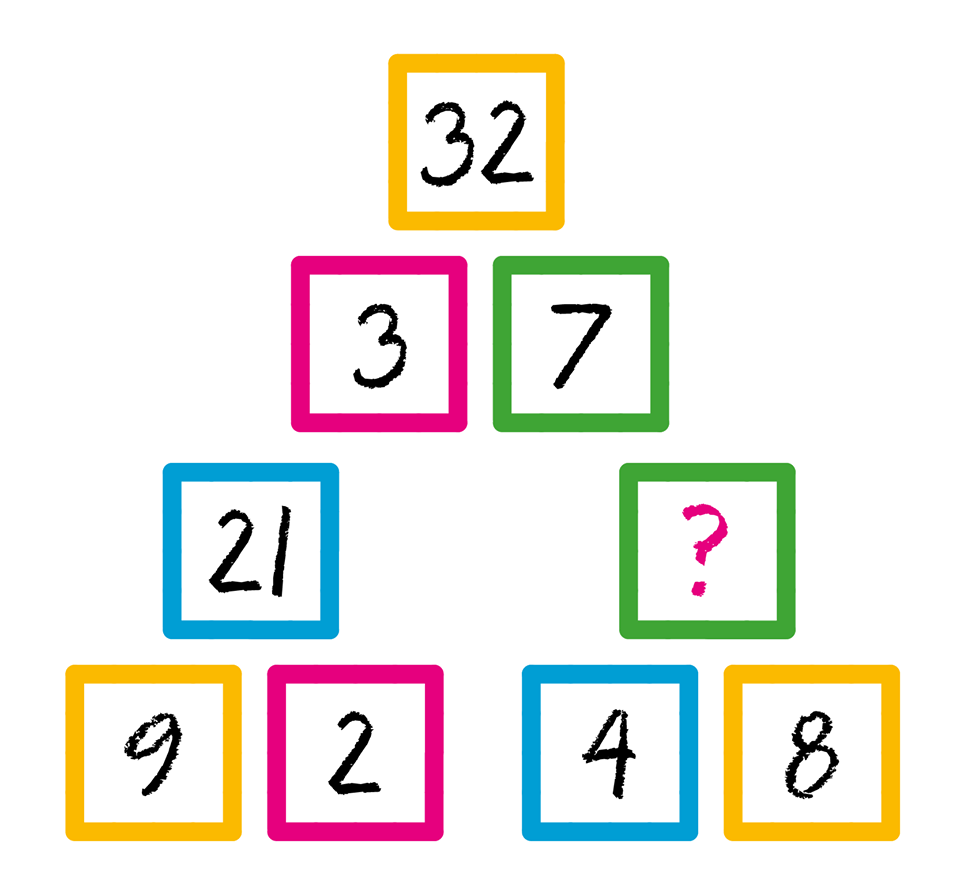
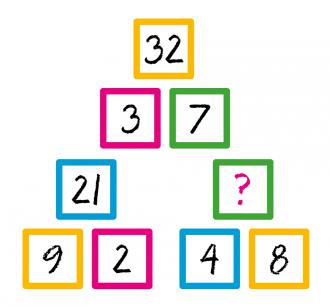
Replace the question mark with a number
[3629] Replace the question mark with a number - MATH PUZZLE: Can you replace the question mark with a number? - #brainteasers #math #riddles - Correct Answers: 82 - The first user who solved this task is Fazil Hashim
BRAIN TEASERS
enter your answer and press button OK

Replace the question mark with a number

MATH PUZZLE: Can you replace the question mark with a number?
Correct answers: 82
The first user who solved this task is Fazil Hashim.
#brainteasers #math #riddles
Register with your Google Account and start collecting points.
Check your ranking on list.

Welfare Office

A woman went down to the Welfare Office to get aid.

The office worker asked her, "How many children do you have?"

"Ten," she replied.

"What are their names?" he asked.

"David, David, David, David, David, David, David, David, David and David," she answered.

"They're all named David?" he asked "What if you want them to come in from playing outside?"

"Oh, that's easy," she said. "I just call 'David,' and they all come running in."

"And, if you want them to come to the table for dinner?"

"I just say, 'David, come eat your dinner'," she answered.

"But what if you just want ONE of them to do something?" he asked.

"Oh, that's easy," she said. "I just use their last name!"

Jokes of the day - Daily updated jokes. New jokes every day.
Follow Brain Teasers on social networks

Brain Teasers

puzzles, riddles, mathematical problems, mastermind, cinemania...

Curie marriage

In 1895, Pierre Curie married Marie Sklodowska (Curie) in Sceaux, France. In 1896, Marie Curie decided to investigate Henri Becquerel's discovery of the radiactivity of uranium, as a research topic for her doctoral thesis. Pierre subsequently followed her into research into radioactivity (1898), for which they were later awarded a Nobel Prize. In 1897 she gave birth to a daughter, Irène who later married Frédéric Joliot and became Irène Joliot-Curie (1926). With her husband, she continued the family's work into radioactivity. They, too, received a Nobel Prize (1935).
This site uses cookies to store information on your computer. Some are essential to help the site properly. Others give us insight into how the site is used and help us to optimize the user experience. See our privacy policy.