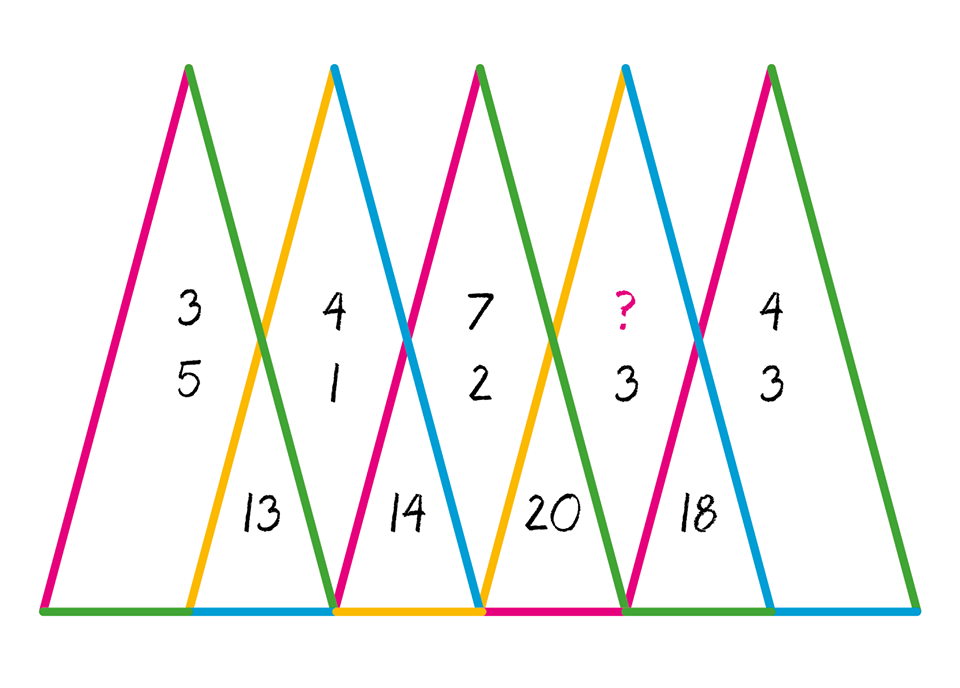
Replace the question mark with a number
[4096] Replace the question mark with a number - MATH PUZZLE: Can you replace the question mark with a number? - #brainteasers #math #riddles - Correct Answers: 98 - The first user who solved this task is Fazil Hashim
BRAIN TEASERS
enter your answer and press button OK

Replace the question mark with a number

MATH PUZZLE: Can you replace the question mark with a number?
Correct answers: 98
The first user who solved this task is Fazil Hashim.
#brainteasers #math #riddles
Register with your Google Account and start collecting points.
Check your ranking on list.

Chinese Jews

Sid and Al were sitting in a Chinese restaurant.
"Sid," asked Al, "Are there any Jews in China?"
"I don't know," Sid replied. "Why don't we ask the waiter?"When the waiter came by, Al said, "Are there any Chinese Jews?"
"I don't know sir, let me ask," the waiter replied and he went into the kitchen.
He quickly returned and said, "No, sir. No Chinese Jews."
"Are you sure?" Al asked.
"I will check again, sir." the waiter replied and went back to the kitchen.
While he was still gone, Sid said, "I cannot believe there are no Jews in China. Our people are scattered everywhere."
When the waiter returned he said, "Sir, no Chinese Jews."
"Are you really sure?" Al asked again. "I cannot believe there are no Chinese Jews."
"Sir, I ask everyone," the waiter replied exasperated. "We have orange jews, prune jews, tomato jews and grape jews, but no one ever hear of Chinese jews!"

Jokes of the day - Daily updated jokes. New jokes every day.
Follow Brain Teasers on social networks

Brain Teasers

puzzles, riddles, mathematical problems, mastermind, cinemania...

Christian Konrad Sprengel

Died 7 Apr 1816 at age 65 (born 22 Sep 1750). German botanist and teacher whose studies of sex in plants led him to a general theory of fertilization which, basically, is accepted today. Although director of a school at Spandau and tutor in Berlin, he devoted himself chiefly to the study of flowering plants. Sprengel's 1793 treatise [illustration at left] on floral structure examines the ways that flower colors, scents, shapes, and markings work harmoniously to attract insects for pollination. A clergyman and botanist, he spent his life researching the role played by the wind and insects in the fertilization of flowers. Although Sprengel's work was neglected by his contemporaries, Charles Darwin later praised Sprengel's work and brought it brought to public attention.
This site uses cookies to store information on your computer. Some are essential to help the site properly. Others give us insight into how the site is used and help us to optimize the user experience. See our privacy policy.