Until I am measured, I am not ...
[2864] Until I am measured, I am not ... - Until I am measured, I am not known. Yet how you miss me, When I have flown! What am I? - #brainteasers #riddles - Correct Answers: 80 - The first user who solved this task is On On Lunarbasil
BRAIN TEASERS
enter your answer and press button OK

Until I am measured, I am not ...

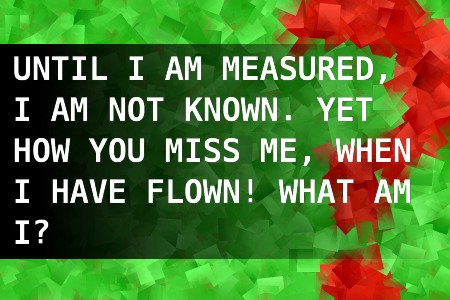
Until I am measured, I am not known. Yet how you miss me, When I have flown! What am I?
Correct answers: 80
The first user who solved this task is On On Lunarbasil.
#brainteasers #riddles
Register with your Google Account and start collecting points.
Check your ranking on list.

A woman was sure that her husb...

A woman was sure that her husband was cheating on her, and having an affair with the maid. So she laid down a trap.
One evening she suddenly sent the maid home for the weekend and didn't tell the husband.
That night when they went to bed, the husband gave the old story: Excuse me my dear, my stomach aches, and went to the bathroom.
The wife promptly went into the maid's bed. She switched the lights off. When he came in silently, he wasted no time or words but quickly got on top of her...
When he finished and was still panting, the wife said: "You didn't expect to find me in this bed, did you?" And then she switched on the light...
"No madam," said the gardener.
Jokes of the day - Daily updated jokes. New jokes every day.
Follow Brain Teasers on social networks

Brain Teasers

puzzles, riddles, mathematical problems, mastermind, cinemania...

Johann Christian Fabricius

Born 7 Jan 1745; died 3 Mar 1808 at age 63.Danish entomologist who was one of the great entomologists of the 18th century. After studying with Swedish naturalist Linnaeus, Fabricius travelled widely in Europe to see insect collections and produced many publications describing all the new species that he saw. He named and classified some 10,000 species of insects. The system of classification of insects he developed was based on mouth structure (instead of wing). He offered theories, progressive for his time, suggesting that hybridization could produce produce new species or varieties, and that environmental adaptation could influence changes in anatomical structure or function.
This site uses cookies to store information on your computer. Some are essential to help the site properly. Others give us insight into how the site is used and help us to optimize the user experience. See our privacy policy.