
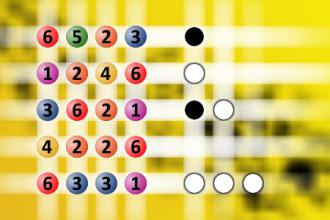
What a winning combination?
[2073] What a winning combination? - The computer chose a secret code (sequence of 4 digits from 1 to 6). Your goal is to find that code. Black circles indicate the number of hits on the right spot. White circles indicate the number of hits on the wrong spot. - #brainteasers #mastermind - Correct Answers: 73 - The first user who solved this task is Djordje Timotijevic
BRAIN TEASERS
enter your answer and press button OK

What a winning combination?

The computer chose a secret code (sequence of 4 digits from 1 to 6). Your goal is to find that code. Black circles indicate the number of hits on the right spot. White circles indicate the number of hits on the wrong spot.
Correct answers: 73
The first user who solved this task is Djordje Timotijevic.
#brainteasers #mastermind
Register with your Google Account and start collecting points.
Check your ranking on list.

A redneck goes to a drug store...

A redneck goes to a drug store and says to the pharmacist, "I got a hot date tonight, and I need me some protection. How much is a pack of them rubbers gonna cost me?"
The pharmacist responds, "A three-pack of condoms is $4.99 with tax."
"Tacks!" the shocked redneck says. "Don't they stay on by themselves?"
Jokes of the day - Daily updated jokes. New jokes every day.
Follow Brain Teasers on social networks

Brain Teasers

puzzles, riddles, mathematical problems, mastermind, cinemania...

John William Draper

Died 4 Jan 1882 at age 70 (born 5 May 1811). English-American chemist who pioneered in photochemistry. He recognized that light initiated chemical reactions as molecules absorbed light energy. The Draper Point is the name given to the point at which all substances glow a dull red (about 525 degrees C.). He described the effect of rise in temperature as the addition of more and more of the visible light region produced a white glow (1847). His interest in spectroscopy and photography was applied to give the first astronomical photograph. Its subject was the moon (1840). He also studied photographs of the solar spectrum to show that contained both infrared and ultraviolet light. His photographs of persons include the oldest surviving photographic portrait (1840), and he was one of the first to produce microphotographs.
This site uses cookies to store information on your computer. Some are essential to help the site properly. Others give us insight into how the site is used and help us to optimize the user experience. See our privacy policy.